A significant reporting error occurred during the DOJ vs. Penguin Random House antitrust trial in August 2022 when an unsourced statistic regarding book sales was published. The trial involved the US government attempting to demonstrate that books with advances of $250,000 or more are treated differently by publishers, claiming that such a situation would harm authors if PRH, the largest of the Big Five publishers, acquired Simon & Schuster. Ultimately, the DOJ won the case, preventing the acquisition.
Read More
Throughout the trial, numerous publishing statistics were discussed, many of which lacked adequate sourcing. In an article dated August 31, 2022, titled “DOJ vs. PRH: The Key Questions of the Trial,” the author noted that of 58,000 trade titles published annually, half sell fewer than twelve copies, and additionally, 90% sell fewer than 2,000 copies. While the latter statistic is generally accepted in industry discussions, the former stirred considerable disbelief among the public and the literary community. This surprising claim went viral on social media after a reader quoted it, causing widespread concern and misinterpretation.
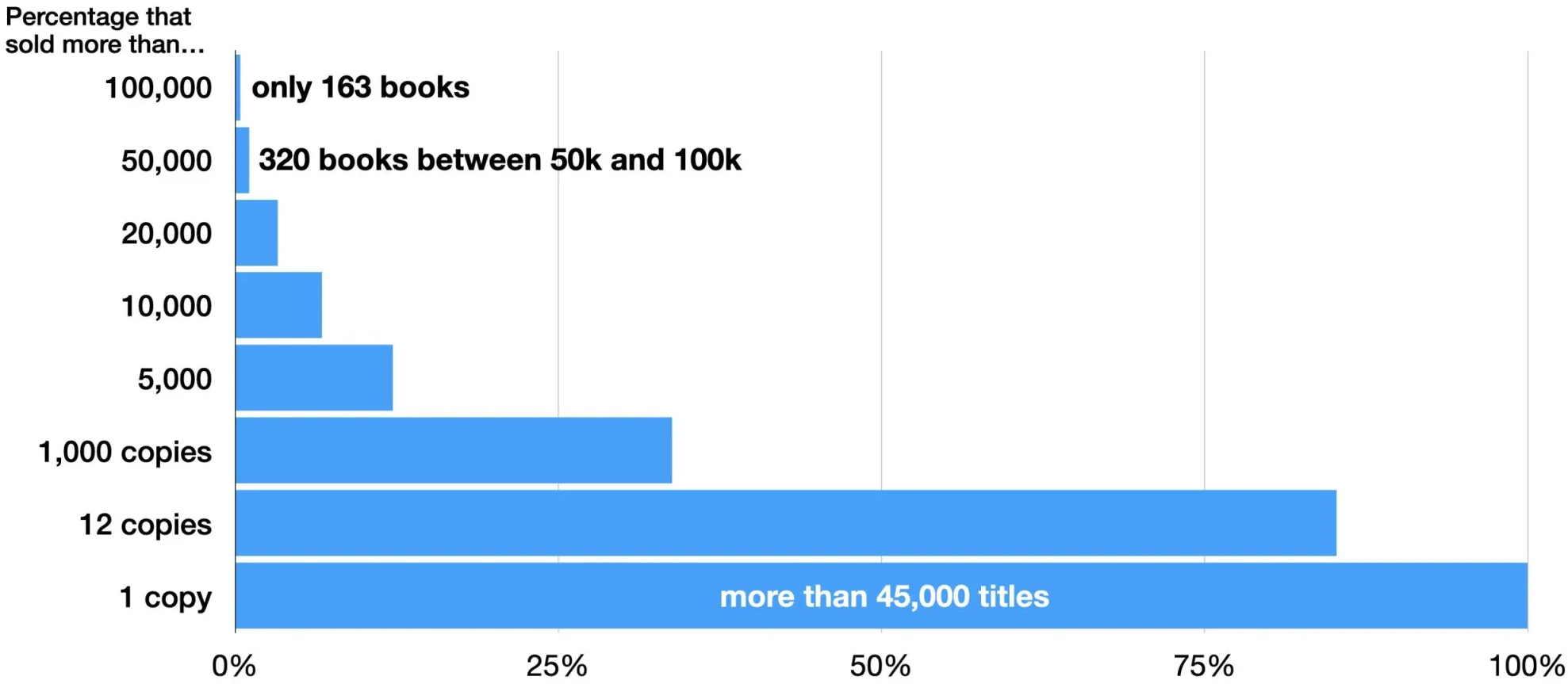
Lincoln Michel, an author and industry commentator, remarked on the statistic, suggesting it likely stemmed from BookScan data, which tracks US print sales through retail channels. The distinctions in sales metrics were emphasized by Kristen McLean, a BookScan analyst, who analyzed and published provisional data indicating that about 15% of new books from major publishers sold fewer than twelve copies. In contrast, she asserted that approximately 66% of these titles sold less than 1,000 copies, with fewer than 2% exceeding 50,000 sales—a clearer depiction of publishing dynamics.
Circana BookScan figures are exclusively based on US print retail sales and do not account for direct publisher or author sales, ebook and audiobook sales, library sales, or sales through international channels. These limitations lead to an incomplete view of overall book sales. Additionally, the Association of American Publishers provides sales data through its StatShot service, but it is limited to AAP member sales, excluding many publishers such as Sourcebooks.
Self-publishing statistics often go unpublished, despite the growing importance of platforms like Amazon, which does not share specific data on ebook sales. Bookstat, which began as Author Earnings in 2014, extracts estimates from Amazon sales rankings and is currently one of the leading sources for analyzing self-publishing and ebook sales data.
As book sales figures gained attention, recent discussions have revisited the topic following reports of Lindy West’s memoir selling only 1,800 copies in its first week, despite extensive media coverage. While some commentators suggested these sales were typical for the industry, others pointed to possible discrepancies, with many celebrity authors seeing significant ebook sales.
In reflecting on the original claim that half of all books sell fewer than twelve copies, the conversation has revealed conflicting interpretations and the necessity for accurate sourcing. Though McLean acknowledged the limitations of BookScan in capturing the full sales picture, she emphasized that they reflect the economic realities of the publishing market, where a small percentage of titles account for substantial revenue. It remains crucial for authors and industry professionals to navigate these figures carefully to understand the complexity of book sales.
The historical context of book sales tracking changed in 2001 when Nielsen launched BookScan, marking the first time industry-wide sales could be monitored. Since then, ownership has shifted to NPD Group, renamed Circana in 2023. Authors can access their own sales data through Amazon Author Central, though full subscription access incurs significant costs and may not guarantee approval.