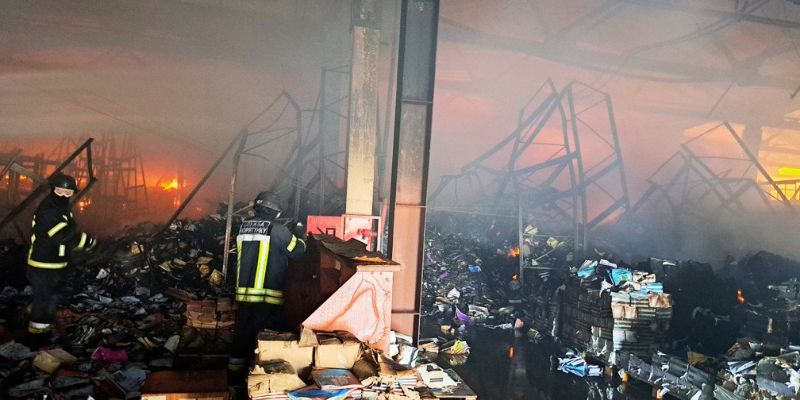
On September 25, The New York Times reported that Russian drone strikes targeted a printing plant near Kyiv, housing millions of children’s books. This incident is part of a broader trend, as Russia has increasingly aimed at presses and publishing houses throughout Ukraine over the past month, raising concerns over the destruction of Ukrainian culture.
Read More
According to the BBC, these attacks have resulted in the loss of one third of all books printed in Ukraine this year. The New York Times additionally noted that Russian shelling has potentially destroyed up to 15 million new books recently.
While exact figures may vary, it suggests that between one third and half of Ukraine’s annual book production has been compromised, risking the future of its literary scene.
Last week’s attack impacted the Ranok Publishing House, one of Ukraine’s largest children's book publishers, coinciding with the crucial back-to-school season. The assault led to the destruction of eight million books in the Ranok warehouse, encompassing 28,000 titles, including 620,000 textbooks designated for students.
Not limited to educational materials, the losses also included various genres. Victor Kruglov, the CEO of Ranok, informed United24 that comic books, international bestsellers, and contemporary Ukrainian fiction were also lost in a fire that lasted over a week. Notable titles destroyed include 6,408 copies of Holly Jackson's A Good Girl’s Guide to Murder, 5,807 copies of Mercedes Ron's Culpa Mía, and 6,647 copies from Max Brallier’s The Last Kids on Earth series.
The Ukrainian Ministry of Culture estimates that the damage amounts to at least $39.3 million (approximately 1.75 billion hryvnias), which only scratches the surface of the cultural impact.
Kruglov emphasized to The New York Times that these attacks are part of a broader strategy aimed at undermining Ukrainian cultural independence. He stated, 'Russia thinks that books are more dangerous for them than military equipment.' He pointed to other recent assaults on additional presses and the National Academy of Science, claiming that Putin aims to erase all connections to Ukrainian culture.
Despite the bleak outlook for the literary landscape, Kruglov conveyed a degree of optimism to ABC, noting the potential for rebuilding. 'That’s probably what’s keeping us going,' he remarked. 'Because we’re able to reprint books, and we’ve kept our team.'