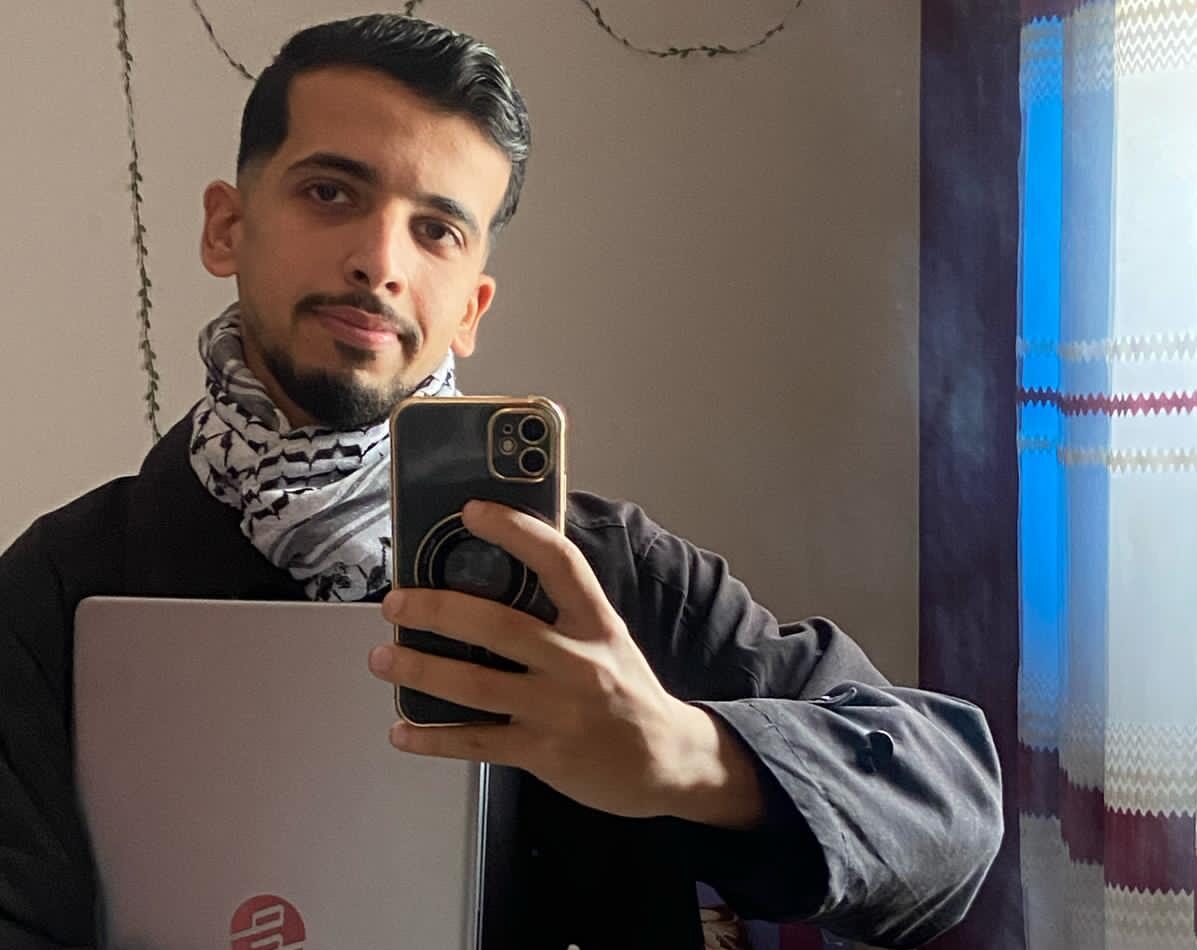
Yahya Al Hamarna is a Palestinian writer and poet from the Gaza Strip, where he faced the ongoing impacts of war and displacement. In an interview, Al Hamarna described his poetic journey, emphasizing that writing became essential for survival amid adversity. His debut poetry collection, My Voice Cannot Be Bombed, published by Iskra Books in 2025, addresses themes of memory, exile, and resilience.
Read More
Al Hamarna studied Political Science and International Relations at Al-Azhar University in Gaza. His work, which encompasses the struggle for human rights and justice, has garnered international attention through social media, where snippets of his poetry have reached diverse audiences globally. Recently, the collection was translated into French, allowing it to reach even more readers.
In the interview, conducted by Angelina Guo for New Bloom Magazine, Al Hamarna reflected on his writing process during the tumultuous years from 2023 to 2025. He articulated that poetry is an act of survival, allowing him to preserve everyday memories amidst ongoing violence. He described his initial foray into poetry as a need for expression, shaped by his childhood experiences, particularly the tales told by his grandfather about their homeland, Zarnoqa.
Al Hamarna's poetry often captures the intimate details of life in Gaza, from the scent of bread to family gatherings. He noted that writing has become a form of resistance, stating, "Writing is the last line of defense. Before buildings collapse, they try to erase our stories."
The poet shared his insights on translation as a vital connection between cultures, expressing the significance of carrying the emotions of his work into other languages. He also discussed the powerful paradox of his words traveling far beyond Gaza, even as he remains physically confined there.
Acknowledging the influence of various authors, including Palestinian literary figures like Ghassan Kanafani and Mahmoud Darwish, Al Hamarna emphasized the importance of literature in preserving identity and dignity. He continues to write amidst the challenges he faces and dreams of furthering his education in political science and international relations, viewing knowledge as a form of resistance.
Al Hamarna concluded with a hopeful outlook, expressing his desire to travel, learn, and share his experiences while underscoring the belief that literature can build connections across divides. He remains committed to articulating Palestinian narratives through his poetry.