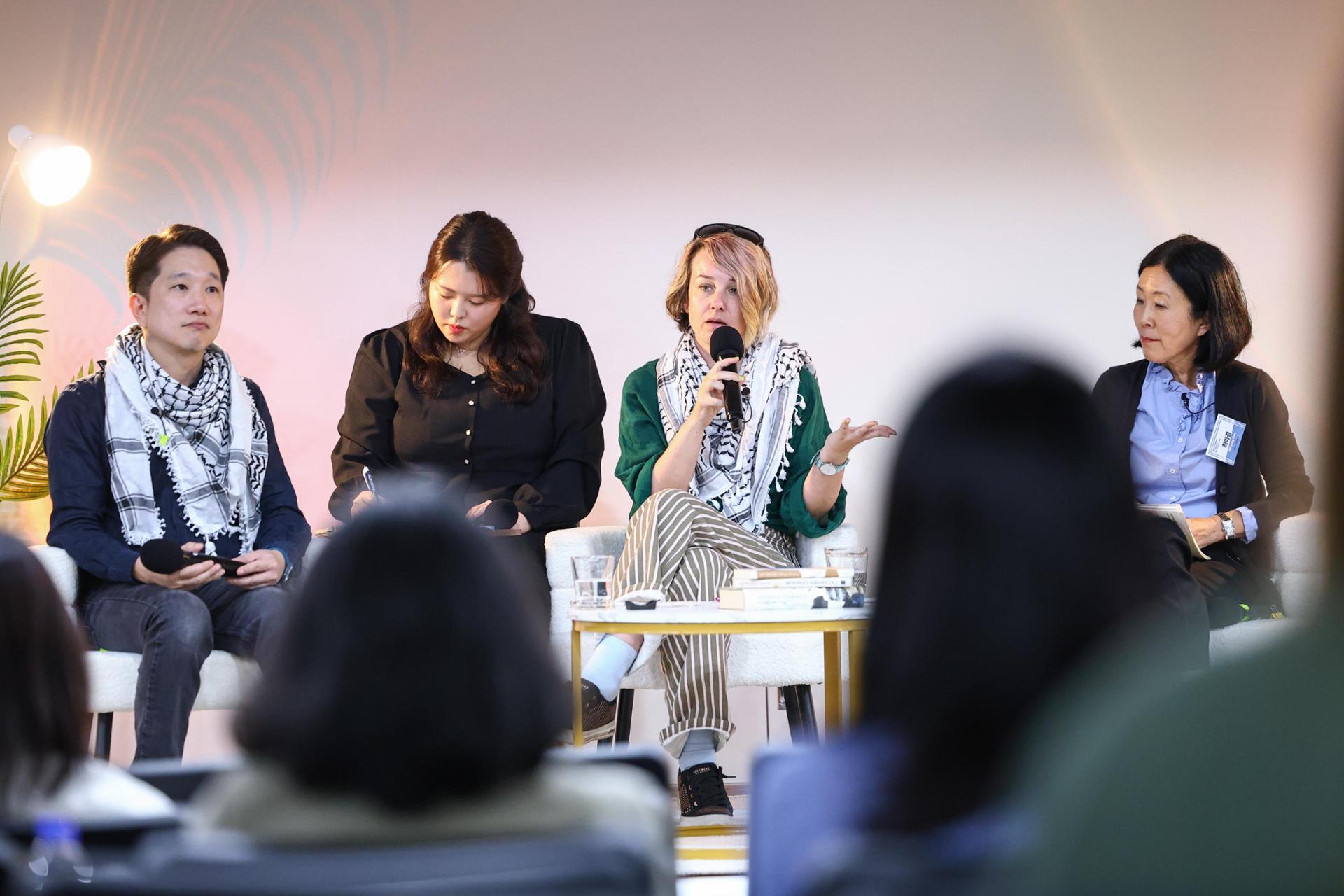
During the international colloquium "Translation: Texts in Transit" held on Thursday at the Museum of World Writing Systems in Incheon, translators voiced the need for increased funding and autonomy for translation efforts to enhance the global standing of Korean literature. Deborah Smith, Anton Hur, and Choi Mi-kyung highlighted that success in this field should not rely solely on individual passion.
Read More
Smith, known for her translation of Han Kang's "The Vegetarian," which won the 2016 Man Booker International Prize, noted the dramatic increase in the availability of Korean literature in UK bookstores compared to when she started learning the language. Both Smith and Hur attributed the recent surge in interest in Korean literature to the persistent efforts of translators across various languages, rather than solely to high-profile awards. Hur emphasized that the Nobel Prize awarded to Han came during Korean literature's rising popularity.
Hur, whose translations of "Cursed Bunny" and "Love in the Big City" were recognized in the 2022 International Booker Prize, acknowledged the growing international readership for Korean literature but warned that visibility alone does not ensure publication. He stressed the importance of continued translation support, mentioning sample translation funding as a key resource for translators seeking to pitch works to foreign publishers. He also cautioned against assuming that the global success of K-pop would automatically generate demand for Korean literature.
Choi, a professor at Ewha Womans University, addressed the shifting policies of the Literature Translation Institute of Korea (LTI), which has increasingly prioritized publisher-led initiatives since 2014, thereby limiting translators' ability to select works and gain direct support. She highlighted that the institute's grant programs that allowed translators to apply directly ended in 2022.
Reflecting on her early translations of Hwang Sok-young's work while he was imprisoned, Choi argued for giving translators the freedom to pursue challenging projects to reach international audiences, regardless of official backing. Smith indicated that the current translation landscape is just the beginning, pointing out that many 20th-century Korean works, including poetry and nonfiction, remain inaccessible in English compared to those from neighboring countries like China and Japan.
The translators collectively noted that a deep love for literature is not sufficient to support them amidst exhaustion and burnout, calling for systemic changes within the industry. They also rejected the notion of AI replacing human translators, emphasizing that translation involves ethical considerations and personal experiences that machines cannot replicate. Smith argued for the unique insights human translators bring, while Hur expressed skepticism towards AI-generated content, asserting that readers have the power to protect genuine creativity. Choi reinforced the idea that literary translation demands an emotional connection that is beyond the capabilities of artificial intelligence.
In a previous session, novelist Hwang Sok-yong echoed these sentiments, distinguishing between authentic human creativity and AI's limitations.