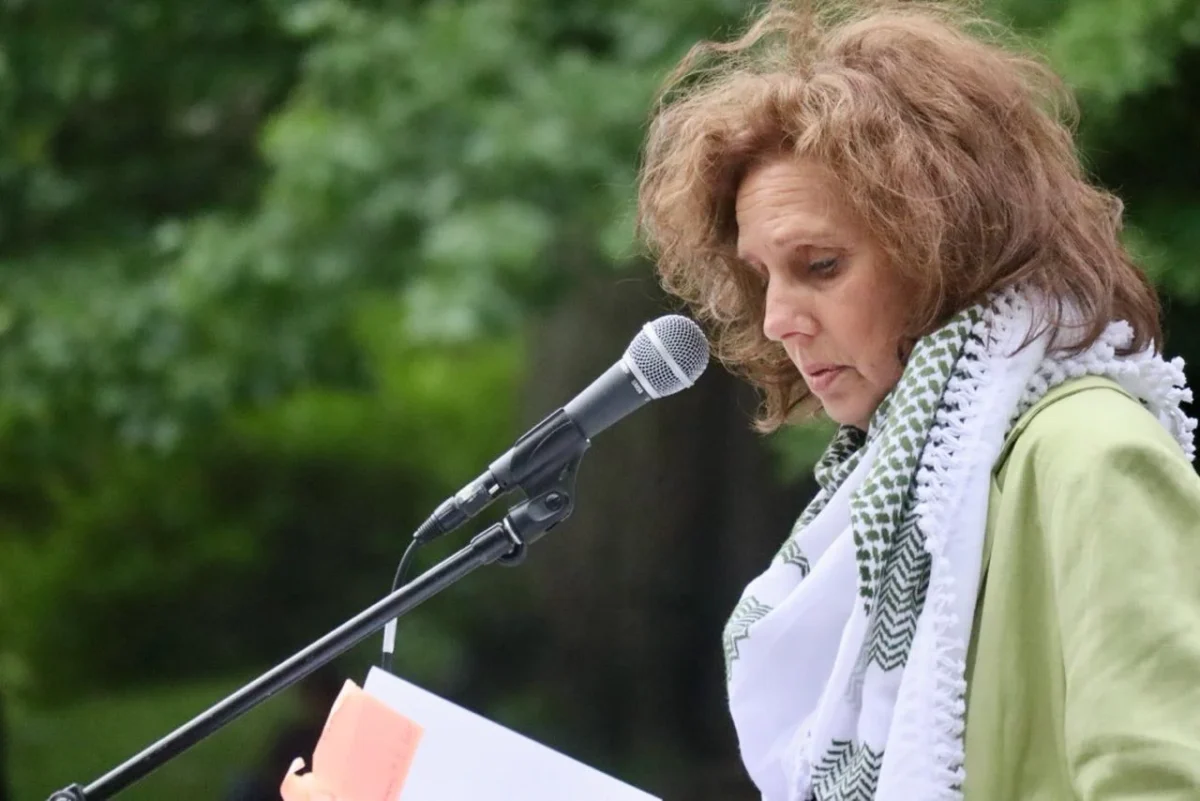
Kathy Engel, a prominent poet and activist, delivered poignant remarks during an event at the New York City Society for Ethical Culture in November 1982, amidst Israel’s invasion of Lebanon and the tragic massacres of Palestinians at Sabra and Shatila. Notably, Engel spoke about the broader implications of silencing voices, particularly that of renowned Palestinian poet Mahmoud Darwish, who was denied a visa to attend. In a statement co-authored with fellow poets, she declared the absence of Darwish a diminishment of their collective voice, asserting, "We speak as poets despite the many attempts of different governments to separate and silence us. The poems will not stop."
Read More
Engel's work spans various political contexts, including Palestine and Nicaragua. She emphasizes that poetry is not isolated from social issues; rather, it emerges as a vital form of resistance. In her recent conversations, Engel reflected on her early experiences with anti-nuclear occupations in New Hampshire, where she found solidarity with fellow activists.
In her writing and activism, Engel navigates complex themes, blending personal and political narratives. Her belief in the essential role of poetry in social movements has been steadfast over her fifty-year career. Engel has published seven poetry collections and is deeply committed to justice, evident in her recent collections, including "Dear Inheritors." Her readings often focus on the struggles of oppressed communities, aiming to raise awareness and foster empathy among her audience.
During her interview for Guernica on July 3, 2025, Engel discussed the challenges of voicing political sentiments in poetry. She acknowledged the risks associated with openly discussing issues like the Israeli-Palestinian conflict, recalling experiences of audience members walking out due to discomfort with politically charged content. Engel's response was to invite individuals to confront their biases, saying, "Hearing it isn’t going to hurt you. It may feel like it hurts you."
Originally identifying as a poet before becoming politically engaged, Engel's activism blossomed through experiences like her participation in anti-nuclear protests. Her commitment to addressing social injustices is a recurring theme in her poetry, which often reflects the interconnectedness of personal experiences with broader political contexts.
The conversation explored Engel’s ongoing internal dialogue regarding her role as a poet and activist, particularly when engaging with subjects outside her personal experience. Advocating for careful and respectful representation, she emphasized the importance of mutual trust and accountability when addressing sensitive topics such as Indigenous rights.
Reflecting on the lessons of the COVID-19 pandemic, Engel remarked on the missed opportunities for collective care and community building. She noted that activism should not merely be reactionary but should involve ongoing dialogues and shared learning.
Throughout her career, Engel has emphasized the significance of beauty and wonder alongside political advocacy in her work. She sees poetry as a conduit for exploring connections with nature and animals, arguing that understanding our relationships within ecosystems can inform our political consciousness.
In her morning practice, Engel engages in reflective activities, often near natural surroundings. This daily ritual helps her connect with the world and prepare for her creative endeavors. Engel's relationships with her environment and the community continue to shape her approach to poetry, activism, and her overall philosophy.
Engel’s abiding faith in community and interdependence underscores her efforts, as she seeks to foster spaces where diverse voices and experiences are honored. Through her unwavering commitment to art and activism, Engel remains a key figure in integrating poetry with social justice.