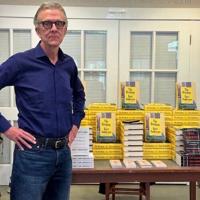
Kurt Andersen's latest novel, "The Breakup," depicts a fractured America facing a second civil war ignited by terrorist attacks in Oklahoma, notably targeting the University of Oklahoma’s Gaylord College of Journalism and Mass Communications and the Will Rogers International Airport. Released on August 18, the book is set in 2045 and follows a family on a road trip to visit colleges for their younger child.
Read More
Andersen, a seasoned author and journalist, aimed to establish Oklahoma as a plausible backdrop for the opening attacks. He stated, "Given the story I’m telling, I thought this should be in a red state, a very red state, obviously, where this militia that gets together and does these attacks could plausibly exist." Having visited Oklahoma frequently for football games and friends, he felt he understood the region well enough to incorporate it into his narrative.
The narrative includes several minor attacks across Oklahoma, with the primary incident occurring in Oklahoma City. Andersen explained that he wanted to highlight the contrast between the city’s diversity and the conservative nature of the state. He reflected, "That conflict within a red state just seemed right as a plausible thing."
He made specific location choices in his story, considering the tactical and symbolic significance of these sites to the fictional terrorists. He noted, "I thought attacking the university and the journalism part of the university was something people like that might choose to do."
The author drew inspiration from the 1995 Oklahoma City bombing, viewing it as a precursor to the attacks in his book. The initial concept for "The Breakup" evolved from his earlier nonfiction works, transitioning from examining America's past to speculating about its future. "If I were going to write another nonfiction book, it would be, ‘What’s the future going to hold?'" he said. "Now, I can write about the future."
Andersen emphasized that his portrayal of the future is not fantastical but rather plausible. He remarked, "It’s not like, ‘Oh, you know we’ll be living on Mars and [artificial intelligence] will be our spouses.’ I was interested in a plausible future."
The author began writing in late 2022, before the public release of ChatGPT, and noted that subsequent developments in politics and AI have sharpened the novel's relevance. Although he considered revising the timeline closer to the present, he chose 2045 for its balance between believability and the potential for change.
Andersen expressed that while he does not believe his fictional future is inevitable, it serves as a reflection on possible realities. He concluded, "To me, the future by nature is fiction... this is what can happen. Look at it. Deal with it, people."
This story was edited by Madisson Cameron. Kylie Caldwell and Sophie Hemker copy edited this story.