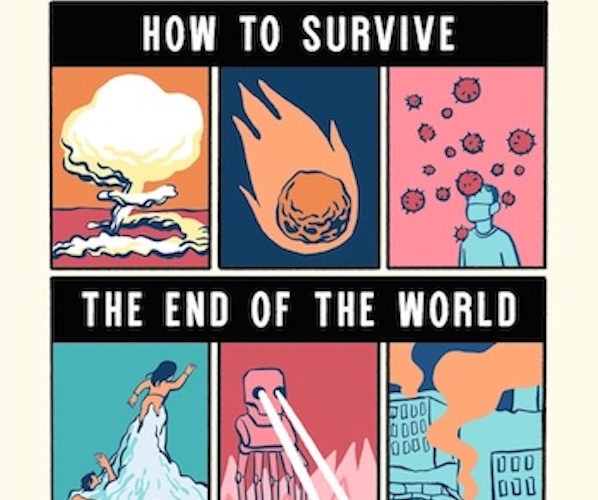
Katy Doughty, author of the young adult non-fiction book *How to Survive the End of the World*, engages readers with both a sense of urgency about global issues and a message of hope. In her book, she covers a range of dangers, including climate change, pandemics, and artificial intelligence, emphasizing human resilience and actionable solutions. The Bulletin of the Center for Children’s Books praises the book for its engaging tone, noting it blends serious topics with humor without resorting to doom-and-gloom.
Read More
Doughty, who holds a BFA in illustration from the Rhode Island School of Design and a Master of Public Health from Boston University, served as the Writer-in-Residence at the Associates of the Boston Public Library from 2021 to 2022. She currently resides in Boston with her family.
Doughty explains that the idea for her book emerged during the COVID lockdown in March 2020, sparked by a passage in Bill Bryson's *A Short History of Nearly Everything* describing an asteroid impact. Initially feeling apocalyptic, she recognized the importance of addressing existential fears in a format aimed at teenagers.
She observes that many adolescents are grappling with climate anxiety, with over half believing humanity is doomed under certain definitions. Doughty points out that this prevailing sense of fear is often misinterpreted as a mental health issue, rather than being acknowledged as a legitimate response to rapid change.
In researching her book, Doughty found the field of astrobiology particularly intriguing, expanding her understanding of life's potential beyond Earth. However, the topic that frightened her the most was climate change, which required extensive research across multiple disciplines and left her feeling a profound sense of urgency and sadness.
Teenagers today are actively engaging in climate action, despite legal disadvantages and limited resources. Doughty highlights youth-led movements and initiatives, noting that young people are not only recognizing their unique position in addressing climate issues but are also creatively organizing at both local and school levels.
Doughty incorporates discussions about colonialism into her exploration of world-ending scenarios, arguing that the impact of colonization mirrors apocalypse in terms of cultural destruction. This perspective was informed by interviews with scholars who liken the effects of colonization to an apocalypse.
When discussing the current anti-science sentiment in the U.S., she emphasizes that simply appealing to scientific authority often fails to resonate with the public. Instead, personal connections and storytelling may offer alternative pathways to foster trust and engagement in scientific topics.
Reflecting on her responsibilities as a parent, Doughty intends to nurture her daughter’s perception of the world without instilling her own anxieties about the future. She acknowledges the challenge of parenting in uncertain times but is committed to fostering a hopeful outlook.
The conclusion of her book encapsulates a mix of dire realities and a vision for a better future that emerged naturally as she developed her work. Doughty asserts that while the subject matter is serious, it carries an underlying beauty and resilience drawn from historical human experiences of overcoming adversity.