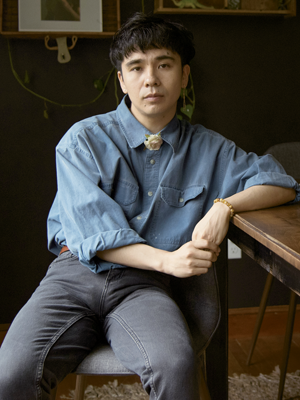
Ocean Vuong published his debut poetry collection, "Night Sky With Exit Wounds," in April 2016. The collection explores the experiences of a refugee family from Vietnam to America, framed through the perspective of a young narrator grappling with family traumas and his sexual identity. The book garnered immediate acclaim, with Michiko Kakutani of The New York Times praising Vuong's vivid imagery and lyricism. It received numerous awards, including the Whiting Award, the T. S. Eliot Prize, and was named one of the top ten books of 2016 by The New York Times.
Read More
Following this success, Vuong transitioned from poetry to fiction with his novel, "On Earth We’re Briefly Gorgeous," published in June by Penguin Press. The narrative focuses on the complicated relationship between a mother suffering from PTSD due to the Vietnam War and her son, who confronts his sexuality amid the challenges of life in Hartford, Connecticut. In a conversation with Vuong, he reflected on his journey, describing himself as "a little gay kid from Hartford, who read in the library with his head down."
Vuong was born in Saigon in 1988 and moved to Connecticut at the age of two with his family after a brief stay in the Philippines. His family, including his grandmother who used song to diffuse conflicts, faced significant cultural adjustments. Vuong’s father returned to Vietnam shortly after their arrival, while his mother began working as a manicurist. Describing his upbringing, he noted, "Everything was erupting all the time, but it was our shared journey that kept us together."
As the only Vietnamese family in a predominantly Black and Puerto Rican neighborhood, the Vuongs received warmth from their community, which helped them adapt to their new life. Vuong recalled being unaware of the racial makeup of America until he was older, and his awareness of white supremacy developed later as he sought opportunities outside of his working-class environment.
During his youth, Vuong dealt with two pivotal realizations: his sexual orientation and his dyslexia, a condition shared by his mother and brother. He later found inspiration in famous dyslexic authors like Octavia Butler and F. Scott Fitzgerald, viewing his learning difference as an artistic advantage. "It’s a different angle of looking at language that reveals a lot and was advantageous for me as an artist," Vuong stated.
His queerness became a source of strength, guiding him to literature as a refuge. When the time came to come out to his mother, he prepared for rejection but was met with support instead. "What would we do without you?" his mother asked, leading him to reconsider his future in Hartford. She encouraged him to pursue college, emphasizing his potential in English.
Vuong briefly attended Manchester Community College, where diverse classmates inspired him to dream. This experience led him to reconnect with poetry, but he initially enrolled in business school at Pace University before dropping out after two weeks. He returned to his literary roots, attending open mics and learning about MFA programs.
Vuong completed his undergraduate degree at Brooklyn College, where he found vital community support among fellow writers. He formed relationships with poets like Saeed Jones and Eduardo C. Corral, who mentored him and shared similar backgrounds. Corral noted Vuong’s attentiveness and curiosity, qualities that have shaped his journey as a writer.
Their continued friendship has fostered a shared mission to represent their immigrant families in poetry, reclaiming their stories in a literary landscape that often excludes voices like theirs.