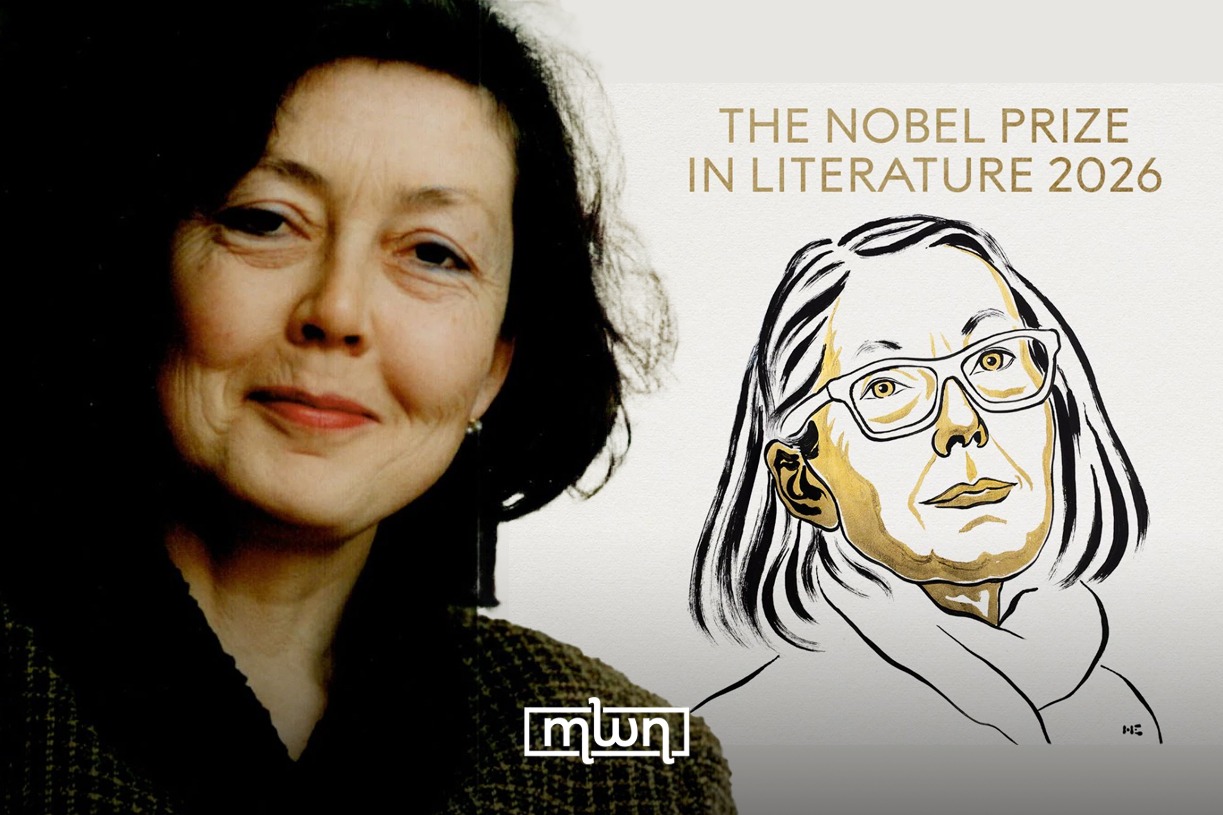
Anne Carson, a Canadian poet, essayist, classicist, and translator, has been awarded the 2026 Nobel Prize in Literature. The Swedish Academy praised her for a body of work that consistently pushes the boundaries of literary genres, intertwining the ancient world with contemporary themes.
Read More
At 76 years old, Carson was recognized for her "bold and inventive oeuvre that, in playful dialogue with the classical tradition, has created new forms for contemporary literature." Her work spans various literary forms, including poetry, prose, literary criticism, translation, and drama, often blurring the lines between them.
Born in Toronto in 1950, Carson’s passion for classical literature ignited in school, where she was introduced to ancient Greek by a Latin teacher. She later pursued her studies at the University of Toronto, obtaining a PhD in classics and teaching at several universities in Canada and the United States;
her classical training has significantly influenced her literary output.
Carson’s first major publication, “Eros the Bittersweet,” released in 1986, analyzed desire through ancient Greek literature and established a characteristic method of intertwining rigorous scholarship with a highly literary form. Her best-known work, “Autobiography of Red,” published in 1998, is described as a novel in verse and reinterprets the Greek myth of Geryon as a narrative of a young person's experiences with love, heartbreak, and identity.
This transformation of classical mythology into a lens for examining modern emotions has become a hallmark of Carson's work. Her publications include “Men in the Off Hours,” blending poems with prose and various forms; “The Beauty of the Husband: A Fictional Essay in 29 Tangos,” which delves into themes of marriage and desire; “Decreation,” traversing poetry, criticism, and dramatic forms; and “Nox,” an experimental work reflecting on her brother's death.
Carson's literary contributions extend to translation, as she has translated works by ancient Greek authors such as Sappho, Euripides, Sophocles, and Aeschylus. Her 2002 work, “If Not, Winter: Fragments of Sappho,” stands out for capturing the essence of Sappho's poetry, highlighting gaps and lost passages rather than trying to conceal them. She views translation as a place of multiple meanings between languages, where ambiguity is embraced rather than avoided.
Her unique approach has solidified her reputation as a distinctive voice in contemporary poetry, earning her numerous accolades, including the Griffin Poetry Prize, the T.S. Eliot Prize, a Guggenheim Fellowship, and a MacArthur Fellowship. Her 2024 collection, “Wrong Norma,” was a finalist for the National Book Award and won the National Book Critics Circle Award.
For Carson, the boundaries separating scholarship and creative writing are not merely formal. Her work expands the horizons of contemporary poetry, blending classical philology, fragments of ancient texts, visuals, essays, philosophical inquiry, autobiography, and mythology.
The 2026 Nobel Prize in Literature honor recognizes an author's entire body of work, and Carson will receive her award, including a medal, diploma, and a prize of 12 million Swedish kronor (approximately $1.2 million) at the Nobel ceremony in Stockholm this December. Ingrid Carlberg, the permanent secretary of the Swedish Academy, informed Carson of her win by phone shortly before the public announcement while Carson was in Iceland, listening to the wind.
The Nobel accolade adds to a career that has profoundly explored and redefined the possibilities of literature.