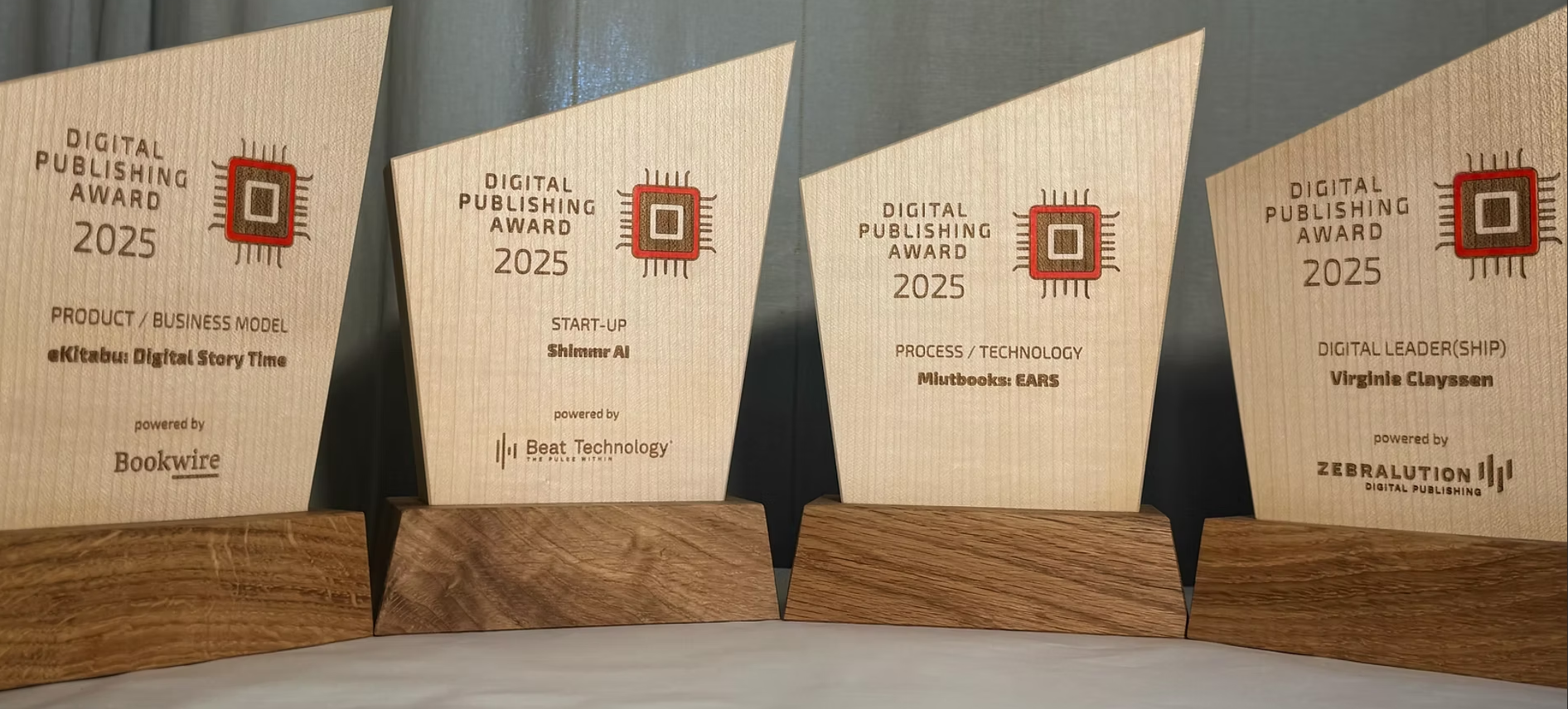
An international jury has selected 12 finalists from a pool of 42 submissions for the 2026 Digital Publishing Award. The finalists hail from Egypt, Germany, India, the United Kingdom, and the United States.
Read More
The shortlisted projects span three categories: Product / Business Model, Process / Technology, and Startup. Artificial intelligence is a prominent theme among the finalists, with emphasis on projects that enhance human work rather than replace it.
Key themes identified in this year’s submissions include accessibility, growth in audio publishing, representation of the Arab publishing market, and innovative author-publisher relationships.
In the Product / Business Model category, India’s Ailaysa Technologies made the shortlist for Ailaysa, an AI-powered translation platform aimed at long-form publishing. The platform preserves terminology, authorial voice, and layout while learning from user corrections. Its Chai Reader feature extends multilingual reading and distribution.
Egypt’s Nahdet Misr Group was recognized for transforming from a traditional publishing house into an education ecosystem that includes digital learning, vocational training, and EdTech investments.
Pocket Entertainment, operating in the U.S. and India, is nominated for Pocket FM, a serialized audio fiction platform that offers both free and paid content, incorporating AI to assist writers in producing, localizing, and monetizing stories.
The United Kingdom's Storywise Technology Services was noted for Storywise Network, which provides opportunities for rejected manuscripts through an AI-based matching system that connects these works with relevant editors and agents.
In the Process / Technology category, Egypt’s Abjjad was shortlisted for Project Genome, aimed at producing Arabic audiobooks, addressing the scarcity of such content despite the Arabic-speaking population exceeding 400 million. This system combines technological innovation with human quality checks, reportedly reducing production costs by 90%.
Germany’s Ernst Klett Sprachen received recognition for allango, which merges hybrid textbooks and digital editions with AI tools that provide feedback for students and teachers.
MPS Limited from India is nominated for a system that generates contextual image descriptions for accessible publishing. Its evaluation model uses AI to ensure quality, with human experts reviewing complex cases.
U.S.-based Pozotron is recognized for Pozotron Studio, which facilitates audiobook production by assisting in script preparation, pronunciation, and proofreading while still relying on human narrators.
In the Startup category, India’s Bookit Digital Technologies was shortlisted for KitabooONE, an AI-based platform that helps academic libraries align curricula and budgets with a vast selection of titles.
Flourworks from the U.S. introduced Whisper by Stck, enabling readers of serialized fiction to interact with characters without spoilers, maintaining author control over character availability.
The United Kingdom’s Pellerin Books was recognized for its reader-centric publishing model and Pellerin Dashboard, which offers authors real-time data on sales, marketing, and royalties.
Germany’s ReadBee is nominated for an app aimed at helping children with reading difficulties by converting printed text into a dyslexia-friendly format.
No shortlist is available for the fourth category, Digital Leader(ship).
Winners in all categories will be revealed on Oct. 7 at 1 p.m. in the Dialogue Networking Area at the Frankfurt Book Fair. The Digital Publishing Award celebrates those advancing the digital transformation in publishing through innovative projects and leadership, expanding internationally in 2025 to include global submissions.
Reports indicate a growing use of AI in European publishing for various applications, including translation and audiobook production. While AI is improving accessibility in smaller markets, concerns remain regarding translation quality and the need for human oversight.