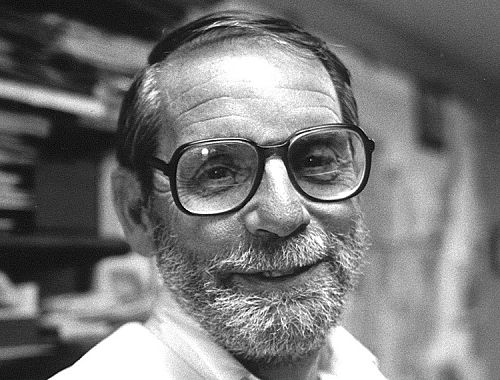
John Angus McPhee, born in Princeton, New Jersey, in 1931, has remained deeply connected to his hometown throughout his life. He often shares nostalgic stories as he navigates familiar neighborhoods, recalling details of his upbringing, such as, “I grew up all over campus. I knew the location of every urinal and every pool table.” His childhood home at 21 Maple Street has remained unchanged, and nearby is the gray stone building where he attended elementary school, now the Lewis Center for the Arts, where he famously remarked, “I flunked kindergarten in the basement of that building.” McPhee’s father served as a university physician at the McCosh Health Center for thirty-six years. Currently, McPhee has an office in Guyot Hall, the same building where he worked as a teenage assistant to biologists, recalling, “My job was killing fruit flies after they finished experiments.”
Read More
McPhee's literary career took off in 1965 with the publication of "A Sense of Where You Are," a book focusing on basketball star Bill Bradley, which allowed him to explore subjects globally while remaining rooted in Princeton. His works include explorations of Alaska in "Coming into the Country," the Swiss Army in "La Place de la Concorde Suisse," and an island in Scotland’s Inner Hebrides in "The Crofter and the Laird." He has tackled themes ranging from the atomic bomb and the environmental movement to sports and geology, producing over thirty books published in The New Yorker, where McPhee has been a staff writer since 1963. His book "Annals of the Former World" earned him a Pulitzer Prize, and he has been recognized with an Academy Award in Literature from the American Academy of Arts and Letters. McPhee has significantly influenced generations of nonfiction writers and has taught nonfiction writing at Princeton since 1975, with about half of his students achieving careers in writing or publishing.
Most conversations with McPhee took place in his office, located on the fifth floor of Guyot Hall, originally a paint closet. Surrounded by Gothic-style windows, scientific maps, and various dictionaries, he has fostered a unique working environment away from the humanities building. McPhee’s style mirrors that of his subjects, focusing on meticulous structure and detail without drawing undue attention to himself. He writes about individuals who share similar passions, such as tennis great Arthur Ashe and canoe maker Henri Vaillancourt.
At seventy-nine years old, McPhee has no plans to retire, maintaining a disciplined exercise regimen that includes a seven-mile bike ride each day along the Delaware and Raritan Canal. He resides with his wife, Yolanda Whitman, and cherishes moments with his four daughters from his first marriage, two of whom are novelists. Despite a preference for privacy and minimal personal writing, McPhee shows warmth and humor, evident when he excitedly celebrated his daughter's completion of her fourth novel, saying, “Bravissima! Fantastic, that’s so wonderful!” His nuanced understanding of the artistic struggle enriches his writing and influences his teaching.