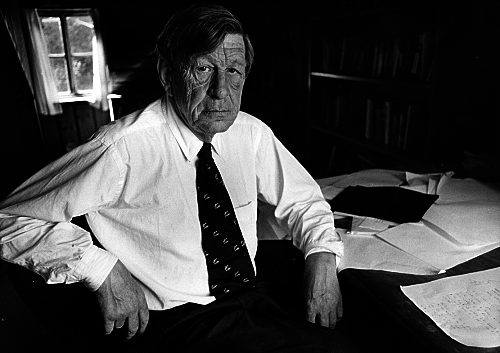
In an interview from Autumn 1972, W. H. Auden humorously proclaimed himself the prime guardian of the integrity of the English language. The conversation took place in his New York apartment, where he was engaged in solving The New York Times crossword puzzle, which on that day featured a review of his latest poetry collection.
Read More
Following the puzzle, Auden glanced at the obituary section before deciding to make toast. When asked if he had read the review of his work, he dismissed the idea, stating, “Of course not. Obviously these things are not meant for me.”
Auden's preferences were evident in the decor of his apartment, used during winter months. The walls of his spacious main rooms were painted dark gray, pale green, and purple, adorned with drawings of friends like Elizabeth Bishop and E. M. Forster, as well as a Blake watercolor and several line drawings of male nudes. His front living room, filled with books, remained dim except for brief moments spent sorting through manuscripts or consulting the Oxford English Dictionary.
In his narrow kitchen, Auden displayed a fondness for unusual foods—tongue, tripe, and Polish sausage—and expressed disdain for beefsteak, associating it with lower social classes. He enjoyed Smirnoff martinis and had experimented with LSD, under a doctor’s guidance, describing the experience as lacking significance, aside from feeling birds might be trying to communicate with him.
His conversations were intelligent and cultured, often steeped in global observations. He relayed an encounter with media theorist Marshall McLuhan, asserting, “I won.”
Auden preferred conducting interviews without tape recorders, reflecting that a good reporter should be able to recall the conversation, recalling a story about Truman Capote. He aimed to preserve the essence of human interaction rather than resorting to the impersonal nature of recorded dialogue. Auden elaborated on his critique of photography, describing it as generating sorrow and voyeurism, thus removing human choice in responding to others' pain.
When questioned about childhood fears, Auden dismissed the notion that darkness frightened him, although he admitted to a lasting fear of spiders and octopi. He characterized himself as a talkative child, with some of his private thoughts remaining unshared. Auden revealed that he had planned to become a mining engineer or geologist before discovering his passion for poetry during a conversation with a childhood friend.
His early reading included various humorous and children's books, and only later did he begin to delve into poetry. He recounted his familiarity with the poet A. E. Housman, who later shared a funny anecdote regarding misquoted poetry.
Auden's relationships extended back to childhood friendships, including Christopher Isherwood, whom he met at St. Edmund's School. He praised the quality of his education, particularly in science, and recounted an interaction with Julian Huxley regarding the identification of a bird's pelvis.
Although he never taught creative writing, Auden believed any such course should focus on the technical aspects of poetry, rather than the act of writing itself. He emphasized the importance of academic subjects over creative endeavors, expressing that the arts could not influence social or political changes effectively.
Auden reflected on the evolution of his poetry as he aged, noting the shifts in his perceptions of England contrasted with his sense of belonging in the United States. He remarked on minor differences in language and nuances between American and British English, which seemed to affect his prose more than his poetry.
Having lived in the U.S. since 1939, including various locations before settling in New York in 1952, Auden commented on his limited interactions with political figures and expressed skepticism regarding writers in leadership roles. He posited that politicians are often disconnected from the public and proposed that leadership should be determined by chance instead of election.
Auden expressed concern over the deterioration of language and meanings, describing his efforts to combat this as a poet. He dismissed the notion that societal decline is indicative of an impending war, asserting that although language has become imprecise, this does not necessarily correlate with future conflict.
He shared insights regarding audience and writing, stating that he does not consciously write for a specific group and that poetry evolves through the balance of theme and form. He emphasized the joy and challenge that form brings to poetry, arguing that true creativity requires some boundaries to unlock genuine expression.