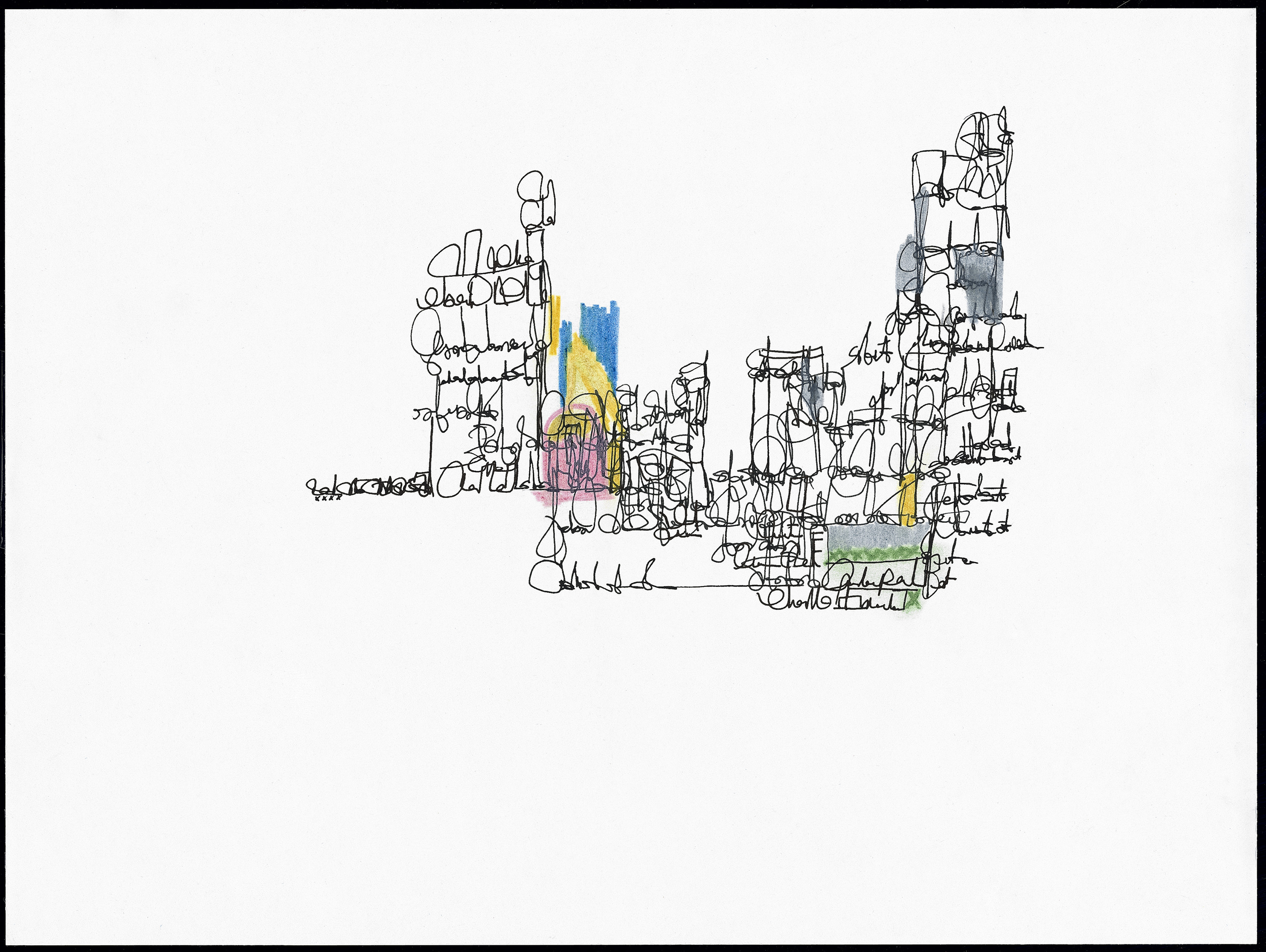
Renee Gladman, a former Harvard Radcliffe fellow, is recognized for her diverse literary work, often classified as “experimental prose.” Her body of work includes the Ravicka series, which depicts a surreal city with a yellow sky, personal essays like the 2016 collection “Calamities,” as well as poetry and visual art. She has also contributed to notable publications such as the poetry and experimental prose press Leon Works and the Leroy chapbook series, while teaching writing and literature at various universities.
Read More
In her novel The Event Factory, which is part of the Ravicka series, a recurring thought from the narrator reflects Gladman's own perspective: “Architecture again, it always comes to that.” Her writing frequently investigates the connection between narrative and architecture, as well as the experience of living within both realms. Recently, this focus has manifested in her concept of “prose architectures,” which are abstract drawings inspired by urban landscapes. These works have been exhibited at venues such as We Buy Gold in Brooklyn and Poet’s House in New York, and featured in her latest publication, Prose Architectures.
During an interview, Gladman discussed her enduring interest in architecture. She explained that her fascination has roots in her earlier desire to write about cities, describing how she views sentences as structures that echo urban spaces. She aims to capture the essence of architecture through these drawings, transforming abstract thoughts into visual representations that convey meaning.
Gladman emphasized the relationship between the body and movement in her work, noting that our physical presence influences how we experience spaces. She believes that the body is central to our understanding of the world, serving as a vessel for thought and experience. In her view, both the body and written language are complex containers through which experiences and memories pass.
When discussing the body’s impact on her writing, Gladman shared that while many explore the physicality of the body—considering aspects such as injury or identity—her concerns are more philosophical. She contemplates the consciousness contained within the body and how it interacts with the world, though she acknowledges the material needs of her own body, such as the desire for companionship or coffee.
Gladman also reflects on the communal aspects of architecture and urban living. She considers how cities facilitate interaction among individuals, acknowledging the isolation she feels while living in a rural barn. This contrast has given her pause, as she contemplates the dynamics of movement within urban settings versus the solitude of her current environment. She perceives buildings as more than mere structures; to her, they are living entities that interact with human life in a dynamic and complex manner.
The interview was conducted by Drew Zeiba. Gladman’s drawings are featured in her book, Prose Architectures, republished with permission of the artist and Wave Books.