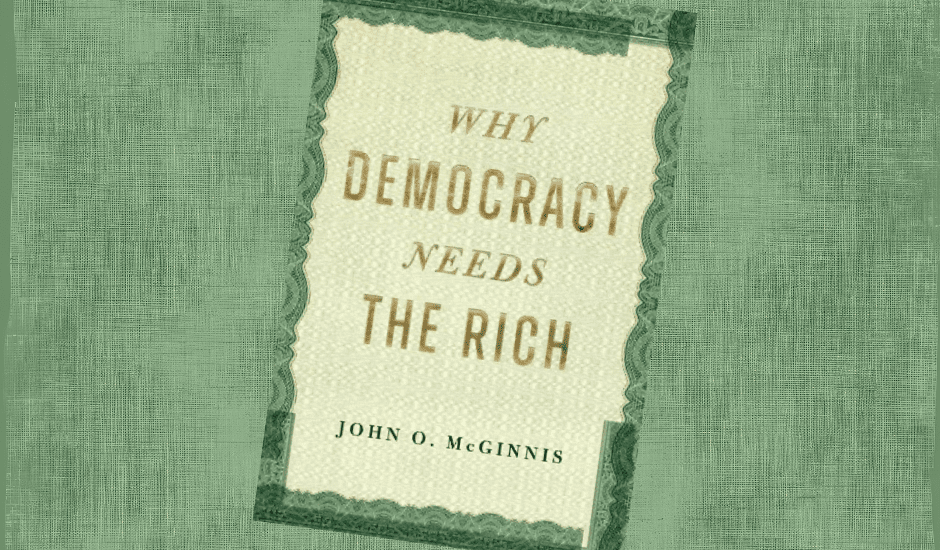
John O. McGinnis, the George C. Dix Professor in Constitutional Law at Northwestern Pritzker School of Law, recently discussed his new book *Why Democracy Needs the Rich* in an interview. With a distinguished background as a former deputy assistant attorney general and editor of the Harvard Law Review, McGinnis has written extensively for outlets including The Wall Street Journal and National Review.
Read More
In his latest work, published by Encounter Books, McGinnis argues against the perspective that ultra-wealthy individuals undermine democracy, positing instead that they play a crucial role in reinforcing democratic institutions. He asserts that wealth acts as a catalyst for democracy by providing independence, counterbalancing elite interests, funding excellence, and renewing liberal democracy over generations. Philanthropy, he emphasizes, is a critical aspect of this relationship.
The conversation covered a variety of subjects, including the nature of America as a commercial and philanthropic republic. McGinnis explained that the founding principles of the U.S. valued commerce for its ability to create wealth and foster cooperation among citizens, helping to diminish social divisions based on factors like religion and ethnicity. He observed that the Constitution's Commerce Clause reflects this aim of enhancing economic interaction.
Philanthropy has always been significant in American society, according to McGinnis. He referenced Alexis de Tocqueville, who noted that Americans have long held a desire to improve society through voluntary associations. McGinnis illustrated that wealthy individuals play an instrumental role in establishing these organizations, acting as the necessary seed capital that enables social improvement efforts. He suggested that a limited government relies on a vibrant philanthropic sector for public goods that the state may fail to provide.
When comparing civil society in Tocqueville’s time to today's nonprofit sector incentivized by tax benefits, McGinnis acknowledged that they are fundamentally different due to the current higher levels of taxation and the larger state apparatus. However, he noted that support for philanthropy in tax policy indicates a societal value placed on these contributions.
McGinnis addressed whether civil society might benefit from being less tied to tax incentives, suggesting that without these structures, governmental support to fill any gaps would likely increase, which he believes would not be advantageous. He argued that public goods and civic engagement encouraged by government serve as necessary supplements and checks on state provision.
Shifting to technology and its implications, particularly artificial intelligence, McGinnis expressed a mix of concerns and optimism, stating that significant changes may be imminent in society. He pointed out that many wealthy individuals are investing in think tanks focused on addressing related challenges, suggesting that they are uniquely positioned to influence sensible regulation in this sphere.
He emphasized the complexity of regulating emerging technologies, cautioning against poorly conceived regulations that could enhance the power of adversarial nations. Additionally, McGinnis highlighted a division between politicians, who may prioritize electoral considerations, and policy experts funded by wealthy individuals who strive to create effective regulations.
Finally, he noted the importance of delineating the role of philanthropy in politics, proposing that while wealthy individuals may engage politically, it may not always be appropriate for their philanthropic efforts to seek tax benefits in support of direct electoral activities. McGinnis concluded that his book offers a contrarian perspective in a climate that often critiques the affluent, underscoring the need for a balanced dialogue on their role in democracy.