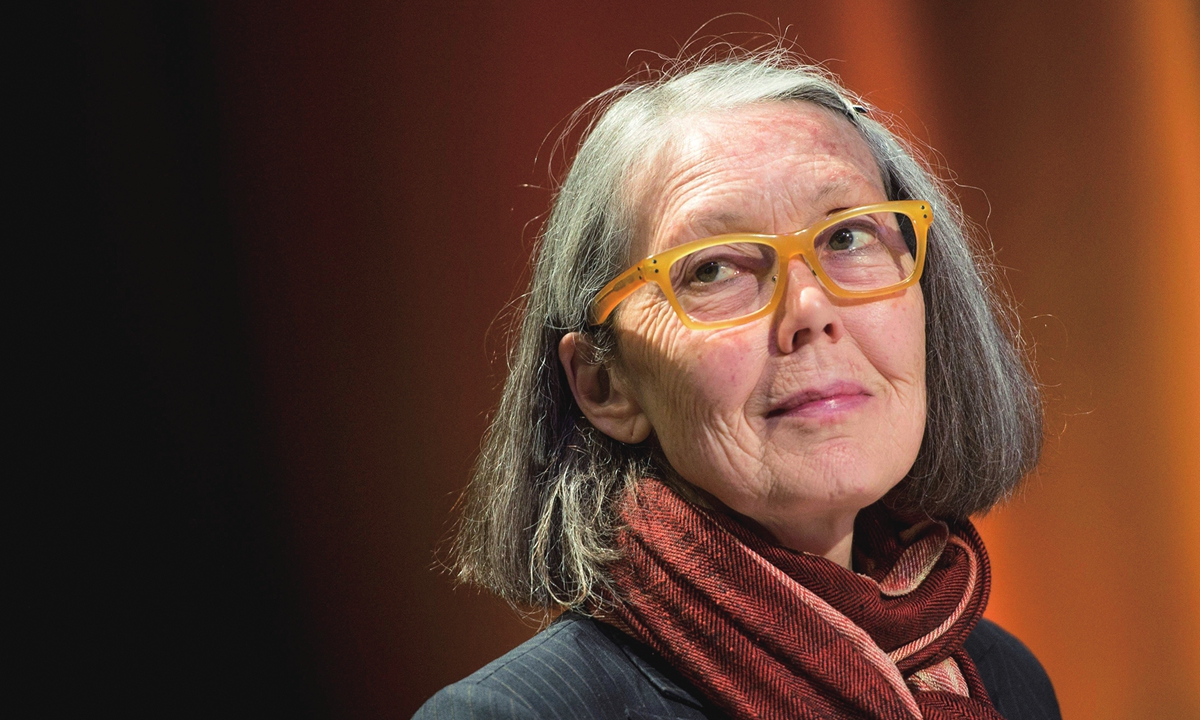
Canadian poet and essayist Anne Carson's Nobel Prize in Literature in 2026 has transformed her from a niche literary figure into a prominent topic in China's reading circles. The announcement has led to a surge in sales of her Chinese translations, particularly her poetry collection Nox, which quickly sold out. This limited-edition work, featuring a unique 26-meter accordion-fold design, was capped at 2,026 copies, and resale prices have reportedly quadrupled on secondhand platforms.
Read More
Yilin Press, which published a combined volume of her works Autobiography of Red and The Beauty of the Husband, reprinted this edition twice within a week following the Nobel announcement, as shared by editor Zhuang to the Global Times. Additional titles, including Men in the Off Hours from the Sichuan People's Publishing House and Plainwater: Essays and Poetry, co-published by Post Wave Publishing and Flower City Publishing, are set to be released soon, further expanding access to Carson's unconventional literary style.
Despite her sudden popularity, questions are emerging about what readers really gain when they engage with Carson's work. The Swedish Academy highlighted her "bold and inventive" literary style, noting her playful dialogue with classical traditions has created new forms in contemporary literature. Translator Cheng Jia emphasized that the descriptors in the Nobel citation—"bold, inventive, and playful"—reflect Carson's approach to form and style. Cheng cautioned that overly domesticated translations could diminish the essence of Carson's unique voice.
Carson's references to Chinese philosophy and poetry, though not central to her work, provide depth to her explorations. In her 2003 essay Totality: The Color of Eclipse, she begins her musings with Chinese interpretations of eclipses before referencing classical Greek origins, blending diverse literary traditions. This ability to connect disparate elements adds layers to her writing, making translation a complex task.
Cheng faced considerable challenges in her translation effort, which began with a deal signed in 2021 and culminated in the finalized work in 2023. She described it as the most difficult project she has undertaken within a contractual timeframe but expressed pride in being a translator of Carson’s work. Zhao Bo, the editor for Plainwater: Essays and Poetry, noted Carson's capacity to find links between seemingly unrelated forms as part of her originality, with the collection oscillating between poetry, essays, and other literary forms.
Cheng advised that readers who find Carson's more experimental writing challenging might start with the less complex prose in Plainwater, as it offers familiar themes and experiences. The recent Nobel recognition could help broaden Carson’s readership in China; however, the true test will be whether audiences delve deeper into her literary fragments beyond the award's acclaim. Cheng remarked that readers' exploration of Carson's work will present a more personal journey filled with classical and experimental echoes.