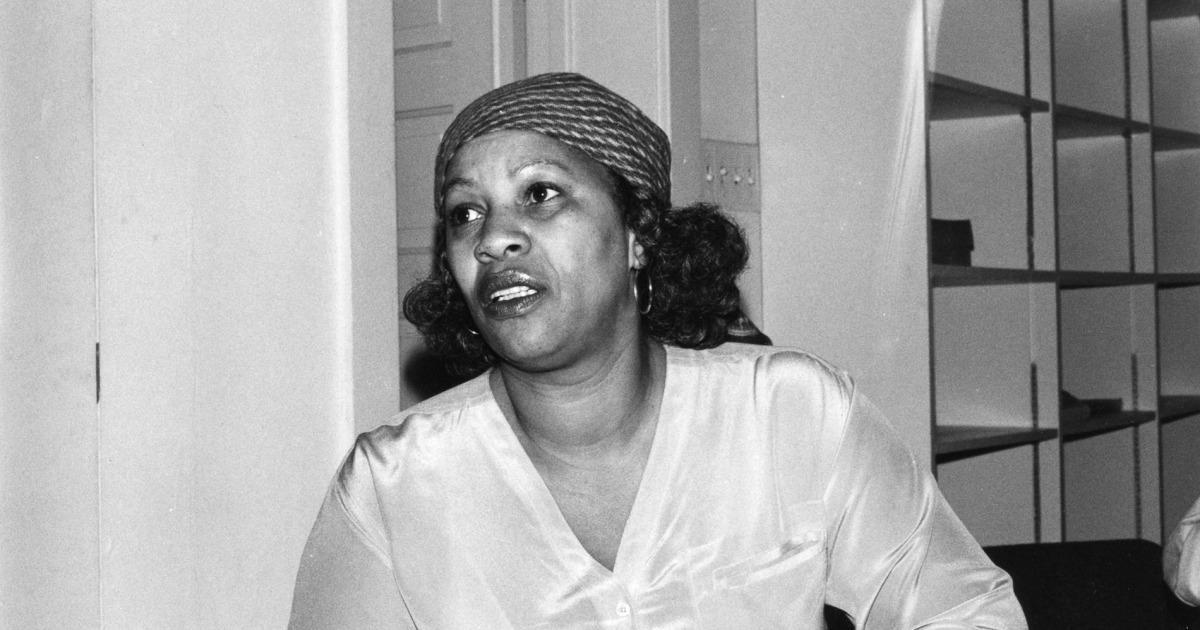
This interview with Pulitzer Prize-winning author Toni Morrison, who passed away on August 5, 2019, originally appeared in the Spring 1980 issue of the Alumnae Bulletin. The article marked the visit of Morrison to campus in the fall of 1979 as the Lucy Martin Donnelly Fellow, during which she read from her novel Song of Solomon and interacted with students.
Read More
Morrison was asked about balancing her various roles as an editor, teacher, writer, and mother. She stated that the true conflict lies not within these activities but with time. She noted that while she often writes under difficult conditions without extended time to dedicate to her work, her compulsion to write allows everything else to fade away. Morrison highlighted that the challenge of writer's block occurs when she is unclear about her writing process, but when she is engaged, she finds that other responsibilities become less overwhelming.
Reflecting on teaching, Morrison expressed that guiding her students in writing about black women’s literature can be challenging due to the lack of existing secondary sources. She found it essential for her students to take critical risks in evaluating the works they study, especially as much literature by women has been misrepresented in the past. Morrison encouraged her students to trust their own insights rather than relying solely on established evaluations.
She emphasized the significance of revision in writing, stating that many students resist the process because it implies their initial drafts are flawed. However, she views revising as an opportunity to refine and enhance their work. Morrison shared her belief that while passion and vision are fundamental to writing, teaching focuses on the craft—the mechanics that ensure clarity and engagement in the narrative.
When discussing her approach to her own novels, particularly The Bluest Eye, Morrison noted that she began with a different concept and embraced the rewriting process as a vital step in discovery. This reimagining is not viewed as a burden but rather a thrilling part of her writing journey.
Morrison also addressed her sense of identity as a writer. Initially, she did not consider herself one until after the publication of her novel Sula when a conversation with her editor helped her recognize her role. She explained that her writing aimed to capture authentic narratives, particularly those of marginalized individuals, focusing on intimacy rather than mass appeal.
Regarding the ability of writers to authentically portray characters outside their own experience, Morrison expressed that it is certainly possible, given the right perspective and openness. She cited examples of several white writers who have successfully engaged with black characters, emphasizing the importance of empathy and the willingness to understand different experiences.
In her final reflections, Morrison encouraged aspiring writers to approach the craft with diligence and awareness of their processes. She stated:
"I have to assume that my students have vision, passion, integrity, brilliant ideas. But many people possess those things, and the problem is moving from there to the writing... The revision for me is the exciting part; it’s the part that I can’t wait for—getting the whole dumb thing done so that I can do the real work, which is making it better and better and better."