Ana María Caballero, a notable voice in contemporary poetry, has gained recognition through award-winning collections that delve into themes of the body, gender, cultural expectations, and emotional vulnerability. Over the past decade, Caballero has expanded the reach of poetry beyond traditional formats, making significant strides in the art world. She pioneered the digitization of her poems on various blockchains and co-founded the Web3 poetry gallery, theVERSEverse, in 2021. In 2024, Sotheby’s marked a milestone by selling her poem ‘Cord’ as a Bitcoin NFT, the first of its kind for a living poet.
Read More
‘Cord’ is part of her collection Mammal (2024), which intimately explores pregnancy and motherhood. Caballero also transformed another poem from the collection, ‘Echo Graph’, into a multimedia exhibition at Office Impart in Berlin in 2025. This exhibition featured a video utilizing motion-capture technology to depict an abstract version of her body in a womb, alongside a book that repeats the poem 197 times. The book's acquisition also included a video of Caballero reading the poem, immortalized on the Bitcoin blockchain. This creative process allowed her to reclaim her narrative surrounding a traumatic emergency C-section, challenging the medical-industrial complex.
Ahead of her institutional survey, Read the Room, at the Francisco Carolinum in Linz, Austria, Caballero discussed her exploration of various artistic forms, the blockchain as both a storage mechanism and a market tool, and the literary implications of artificial intelligence.
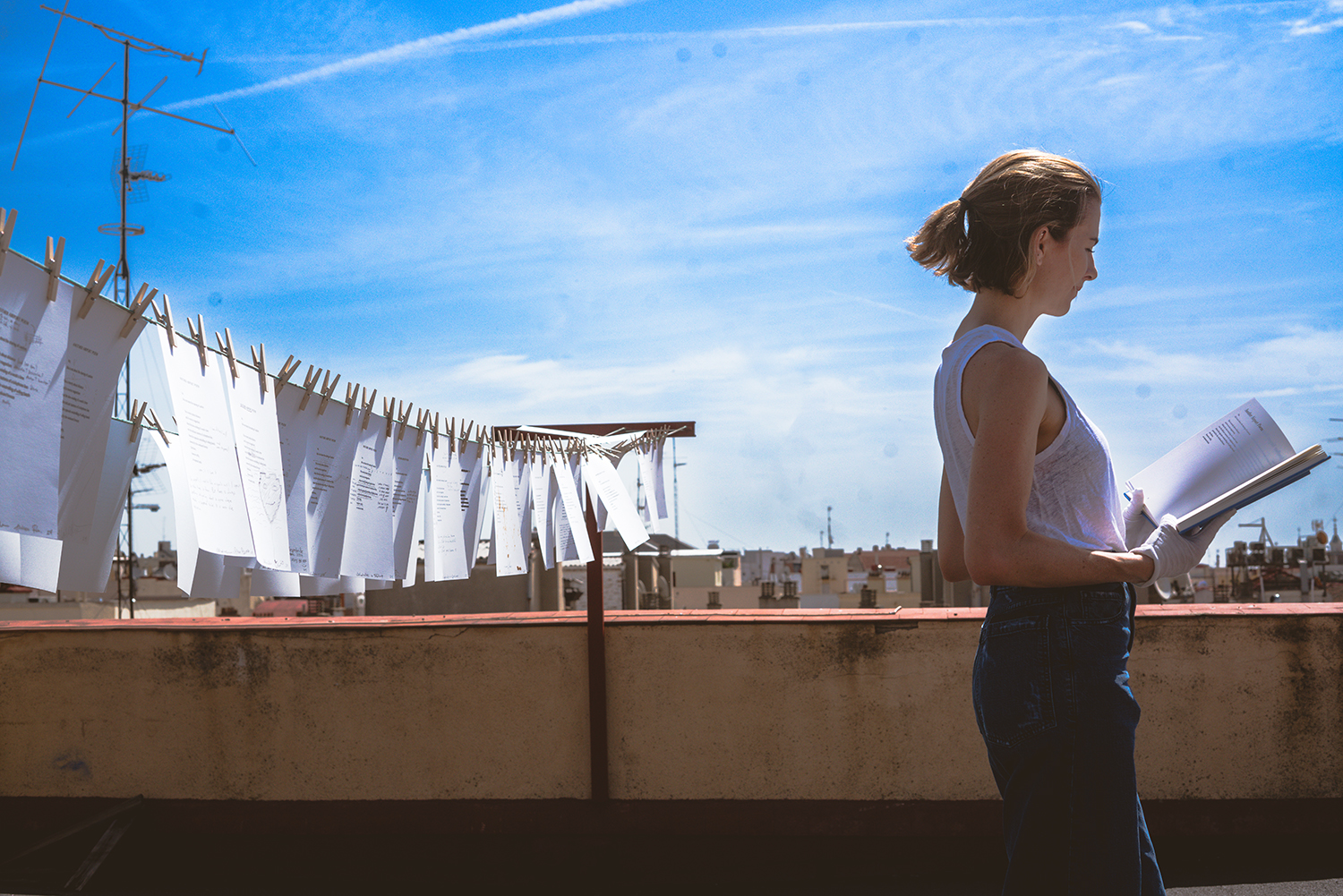
Caballero's project, Fifty Ways of Looking at a Poem, exemplifies her artistic vision. The project began with a single poem that 50 individuals annotated, culminating in an installation, performance, and a collection represented on the blockchain. She views the act of engaging deeply with a poem—marking it up, photographing it—as a form of art in itself.
The process began with her writing a poem titled ‘Another Airport Poem’, which was then annotated by 50 participants, showcasing diverse interpretations. Each annotated poem was digitized into an NFT, while the physical copies were preserved as a unified collection. In a notable performance, she hung the annotated poems as if they were laundry, reflecting a theme within her work that finds transcendence in everyday experiences.
When discussing the significance of digitization, Caballero emphasizes the potential for broader readership and connection. By minting her poems as NFTs, she believes she engages with a wider audience and acknowledges the art market. The blockchain provides a permanent record of her work, akin to carving it into stone, which she finds compelling.
The creation of theVERSEverse was motivated by a desire to incorporate poetry into venues where it is typically absent. Through successful projects funded by grants, she aims to redefine how poetry can be perceived both artistically and commercially.
Addressing her use of AI, Caballero explores its implications in literary creation, particularly through text-to-image generative AI. Her current project, Being Borges (2023–26), combines original poetry inspired by Borges with visual interpretations generated by AI. She notes that her approach to writing incorporates elements typical of AI-generated text to create meaning and engage creatively.
On the topic of copyright in the age of AI, she expresses a more intertextual perspective. While recognizing the broader concerns about technology's impact on creative work, Caballero does not hold a possessive view of her poetry, seeing it as part of a larger artistic dialogue.
In summarizing her artistic journey, she advocates for poetry to exist beyond traditional confines, asserting that allowing poems to transcend their original formats can enrich their meanings and foster deeper connections with diverse audiences.
Read the Room is on display at Francisco Carolinum, Linz, until February 7.