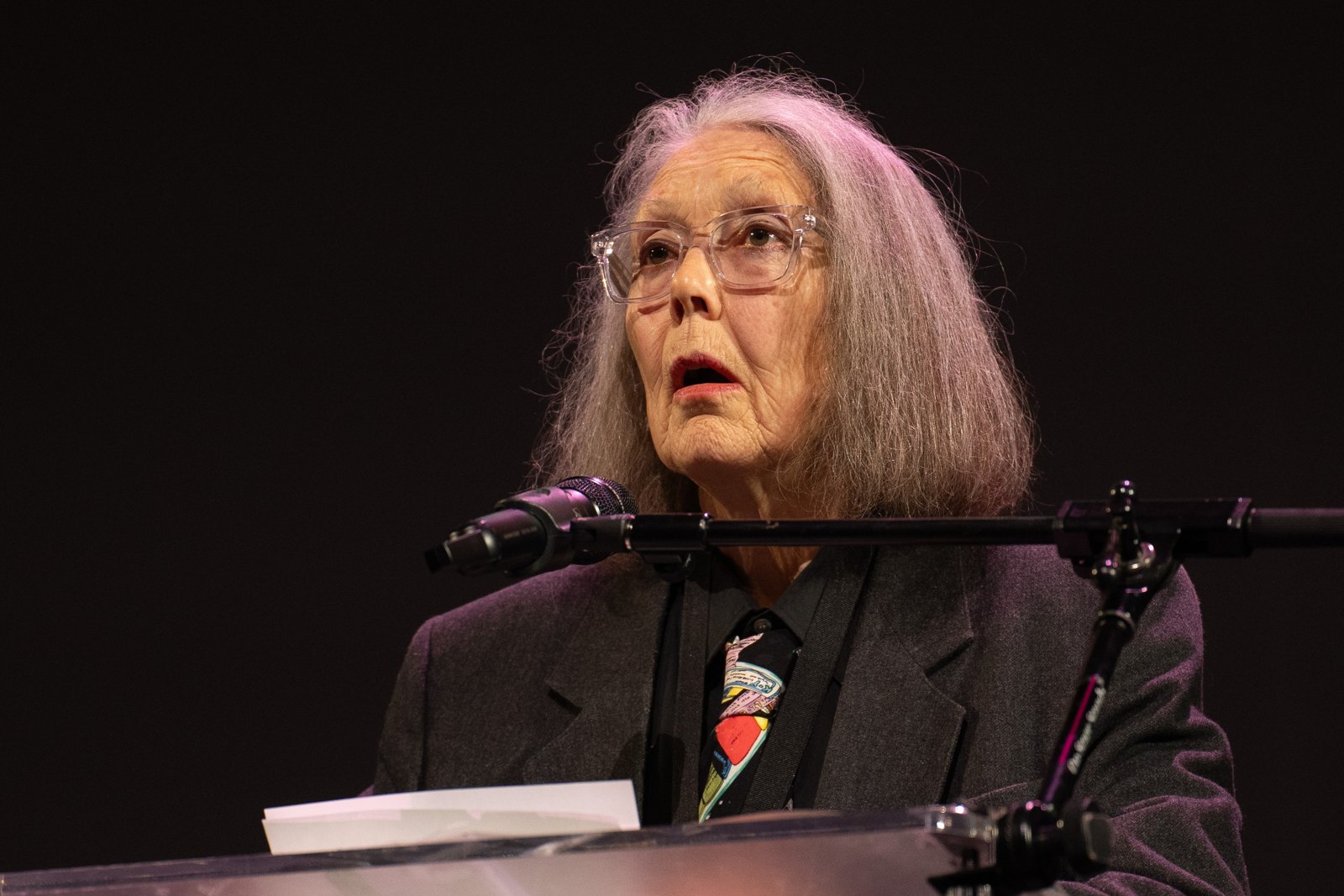
Canadian author Anne Carson was awarded the 2026 Nobel Prize in Literature on October 8 for her innovative integration of poetry, prose, translation, and classical scholarship. The Swedish Academy recognized her for “her bold and inventive oeuvre that, in playful dialogue with the classical tradition, has created new forms for contemporary literature.” The prize is valued at 12 million Swedish kronor, approximately US$1.2 million.
Read More
At 76 years old, Carson became the 19th woman to win this prestigious award since its inception in 1901, with only 18 women among the 122 laureates who have received the prize. She follows Hungarian writer László Krasznahorkai, who was honored in 2025.
Carson was in Iceland when she received the news. Ingrid Carlberg, the permanent secretary of the Swedish Academy, recounted that Carson described the moment as one where she was “listening to the wind.”
Born in Toronto in 1950, Carson has merged creative writing with a focus on classical literature throughout her career. She has taught classics at various universities in Canada and the U.S.
Her work often juxtaposes ancient texts with contemporary themes, resisting traditional literary classifications. The Swedish Academy emphasized her combination of philological expertise and the search for new literary forms in her career.
Notable among her works is Autobiography of Red: A Novel in Verse (1998), which reinterprets the Greek myth of Geryon in the context of modern love and loss. Another significant piece, Norma Jeane Baker of Troy (2019), draws parallels between actress Marilyn Monroe and Helen of Troy, exploring themes of beauty and public obsession through a blend of poetry and dramatic elements.
Carson’s translations of classical texts, including works by Sappho and Euripides, showcase her literary independence. She earned her doctorate in classics in 1981, tying her academic pursuits closely to her literary endeavors.
Her unique publications, like Nox (2010), which presents an accordion-folded book filled with photographs and letters made after her brother's death, and Float (2016), a collection of chapbooks meant to be read in non-linear order, reflect her experimental approach to literature.
Carson’s engagement with literary traditions extends to her reimagining of characters, as seen in The Albertine Workout, which explores memory and desire through the lens of Marcel Proust’s work.
Carson is the third woman to win the Nobel Prize in Literature in five years, following Annie Ernaux in 2022 and Han Kang in 2024. She will receive her medal, diploma, and prize money at the Nobel Prize ceremony in Stockholm on December 10, 2026. The announcement of her award marks her as the fourth Nobel laureate revealed in 2026, with additional prizes to be announced shortly.