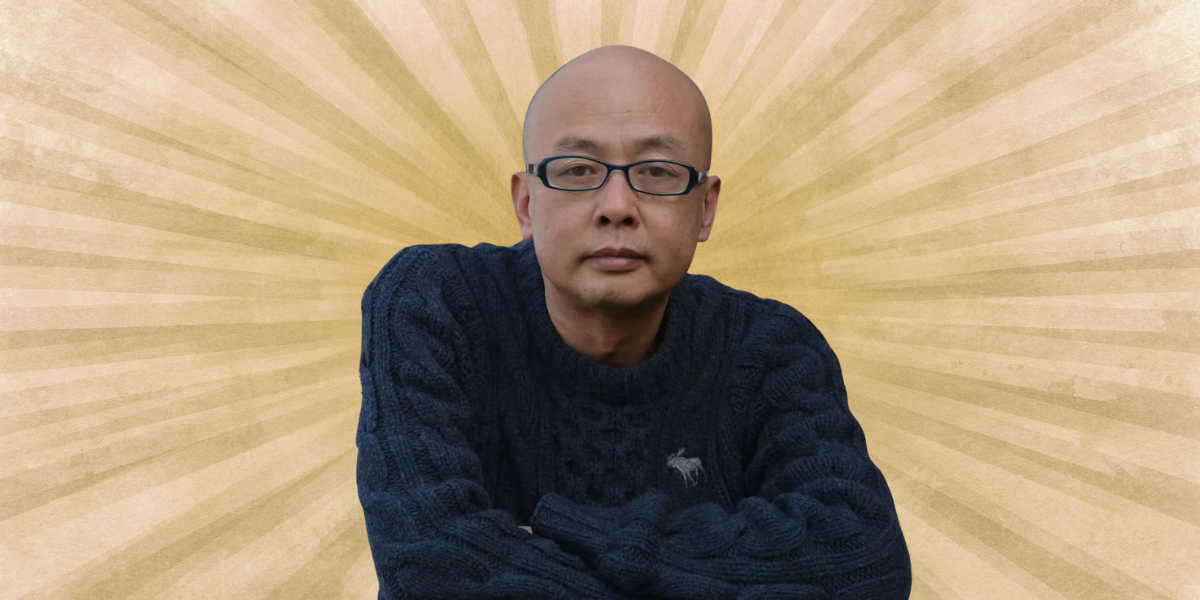
In a recent interview with contributing editor Peter Mishler, contemporary poet Ye Hui discussed his views on translation, his writing process, and the emotional relief that comes with completing a poem. The conversation was facilitated through a messaging app, with English translator Dong Li assisting with translations.
Read More
Ye Hui, a recognized Chinese metaphysical poet from Nanjing, is the author of three poetry collections: 《在糖果店》(At the Candy Shop; 1999), 《对应》(The Correspondence; 2009), and 《遗址》(The Ruins; 2019). His poems have appeared in various English-language publications, and the upcoming translation of The Ruins (Deep Vellum, 2025) has already received a PEN/Heim Translation Fund Grant and was longlisted for the National Book Critics Circle Gregg Barrios Book in Translation Prize.
When asked about the innovations in translation, Ye Hui remarked that discrepancies often awaken his imagination, noting that poems can only be partially conveyed through writing. He expressed appreciation for the re-translation efforts by friends that illuminated details he had overlooked.
Reflecting on his early understanding of poetry, Ye Hui admitted that he initially believed words could communicate everything. Over time, he recognized that some aspects of poetry resist complete expression. He described the completion of a poem as a feeling, one that emerges as relief when he senses that the lines are ready to be set down.
Ye Hui also discussed the intersection between his architectural background and poetry, explaining that he explores the relationship between architecture and people. He considers how different living environments influence emotional experiences and thought processes across time.
Regarding his writing process, Ye Hui typically dedicates 7 to 10 days to writing, locking himself away to focus deeply. He prefers writing on a computer to avoid the distraction of poor handwriting. He spends considerable time on composing, allowing his mind to generate new lines even when not actively writing.
Ye Hui's editing process involves revisiting drafts and making adjustments after a few months. He finds his work influenced by various literary movements and historical texts, particularly the ancient Chinese I Ching, which taught him about the fluidity of time and meaning in language.
When discussing the concept of metaphysical poetry, Ye Hui expressed uncertainty about its definition but acknowledged the influence it has had on his writing. He also touched on his connection to surrealism, noting its evolution and presence in contemporary poetry.
Recent preoccupations for Ye Hui include a project titled Catalogue, where he explores the relationships between the language of his poems and the world around us. He views poetry as a way to navigate life’s complexities rather than a direct approach to expression.
In his closing thoughts on the relationship between poetry and music, Ye Hui articulated how he perceives music to resonate as a primal sound from the world, a force that deeply affects his consciousness but can also feel exhausting.
His poem “Morning Suddenly Becomes Loud” captures these themes, reflecting on memory and existence amid life's transient moments.