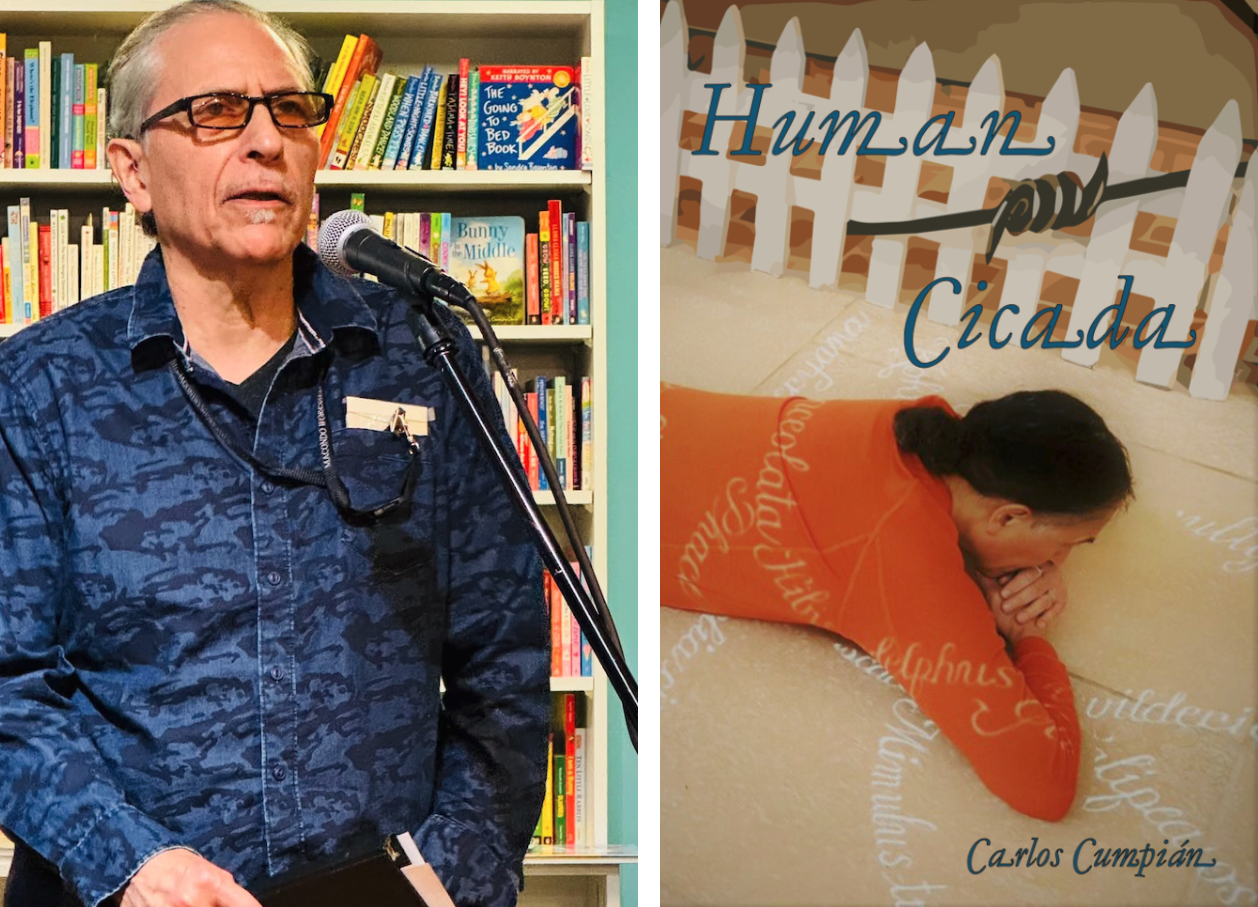
Carlos Cumpián, a poet rooted in Coahuiltecan heritage, is known for his recent work, *Human Cicada* (Prickly Pear Publishing, 2022), along with earlier titles like *Armadillo Charm* (1996), *Latino Rainbow* (1994), and *Coyote Sun* (1990). He is a cofounder of March Abrazo Press, the first small press in Illinois dedicated to Chicano, Mexican, Latina, and Native American literature. Acknowledged for his contributions to poetry, Cumpián was honored by The Instituto Cervantes and DePaul University’s Spanish Department in 2025.
Read More
In an interview with Angelica Flores, Cumpián shared insights into his journey to poetry, recalling that his interest began at fifteen, inspired by a girlfriend who enjoyed writing. He learned about poetry through older students at a local “Youth Coffee House” and identified with the influential works of poets from the Beat movement. Cumpián’s literary influences expanded over the years as he became engaged with various forms of expression, including plays and essays focused on Chicano literature and literacy.
Flores highlighted personal anecdotes in Cumpián's poetry, such as those featuring his grandmother in *Fronterizo Shopping Trip*. Cumpián explained the prose-like quality of some of his narrative poems, emphasizing the balance of storytelling and lyricism.
Discussing the poem *O José, Can you see?*, Cumpián reflected on the connections between his work and that of other poets, specifically mentioning José Olivarez’s *Mexican Heaven* and suggesting that his poem responds to themes of Mexican-American identity.
Cumpián’s poem *Beauty and the Blade*, inspired by his experiences as a high school teacher, captures the complexities of working with diverse student populations. He noted the challenges many teachers face in urban settings while expressing the joy he found in teaching and discussing poetry.
His poem *Haiti (2010)*, written from the perspective of a teenager rescued after an earthquake, demonstrates the power of persona in poetry, though Cumpián expressed hope that the girl was thriving post-tragedy. He also discussed his poem about Tecumseh, emphasizing the marginalization of Native voices in the American literary canon and the importance of recognizing indigenous perspectives.
On writing and overcoming blocks, Cumpián encouraged writers to engage authentically with the world, read widely, and maintain a dedicated writing schedule. He underscored the significance of revising work thoroughly before sharing it publicly.
Cumpián shared his experience running MARCH/Abrazo Press, highlighting the challenges of publishing poetry in an industry where author engagement varies. He noted the evolving landscape of Latine and Chicano/a literature in the U.S., observing a growing academic interest even as traditional readership remains critical.
He and his wife, Cynthia Gallaher, both prominent poets in the Chicago literary scene, mutually influence each other’s work. Cumpián concluded by revealing that his upcoming chapbook, *Road Spider*, is expected to release in October 2026.