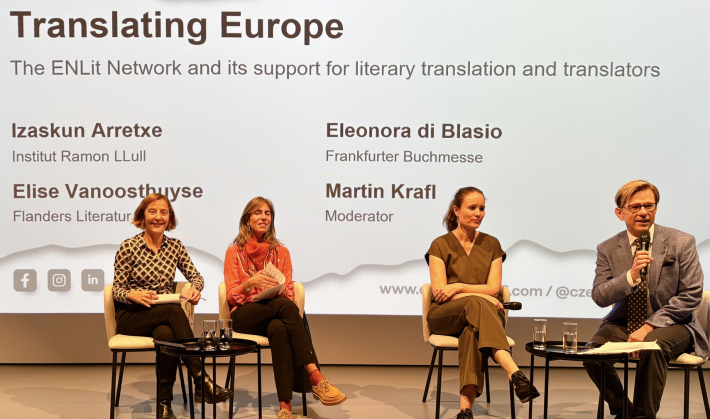
During the 2026 Frankfurter Buchmesse, members of the European Network for Literary Translation (ENLIT) shared insights on their support for translators in Europe. The panel featured Izaskun Arretxe from the Institut Ramon Llull, Elise Vanoosthuyse from Flanders Literature, Eleonora di Blasio from the Frankfurter Buchmesse, and Martin Krafl, head of the Czech Literary Centre (CzechLit).
Read More
With 30 members from 25 countries, including 23 EU countries, Arretxe emphasized that ENLIT has been instrumental in addressing common challenges among translators. Di Blasio noted that the Frankfurter Buchmesse's involvement with ENLIT aligns with its Guest of Honor program's focus on promoting national translation funding.
The ENLIT organization does not provide grants directly but collaborates with member organizations that typically secure government funding for translations. In 2025, the network supported over 4,000 books across 60 languages, providing an average grant of approximately €2,900 per title. The French Centre National du Livre (CNL) awarded the highest total of €1,752,663 in grants, while Czechia allocated €1,580,300, which Krafl attributed to the requirements of the Guest of Honor program.
However, two right-wing senators are proposing to eliminate the CNL's funding starting in 2027 as part of a budget cut plan. Krafl explained that for Czechia, the translations are crucial, stating that this year CzechLit funded translations for 194 books into German, along with additional projects in Spanish, French, and English.
Arretxe reflected on how being featured as a Guest of Honor at the Frankfurter Buchmesse in 2007 significantly impacted Catalonia’s translation landscape. Meanwhile, Krafl mentioned that Czechia has focused on German-speaking markets for the last decade but aims to expand into English-speaking markets.
The panelists agreed on the importance of ensuring translators are compensated fairly since a significant portion of the expenses for publishers involves translation costs. Krafl noted efforts in Czechia to verify that publishers honor payments to translators, as there have been issues with some publishers delaying payments despite receiving grants. Vanoosthuyse shared that regions like Flanders and Catalonia require proof of payment to translators from publishers before awarding grants.
Community-building among translators is another focus for the Institut Ramon Llull, with an upcoming Forum for Literary Translators scheduled for late November in Barcelona, expecting around 150 attendees.
The discussion also touched on the impact of artificial intelligence (AI) on translation. Vanoosthuyse remarked that while AI can serve as a helpful tool, it lacks the ability to convey nuance such as humor and emotion. They are considering adding clauses regarding AI usage in grant contracts. Arretxe indicated they are also mindful of ensuring that translations are completed by humans.
Later in the event, Francesca Novajra, president of the European Council of Literary Translators’ Associations (CEATL), presented survey findings indicating that many in the translation community are apprehensive about generative AI, with 37% contemplating career shifts due to its implications, and 30% reporting a drop in assignments linked to AI advancements.
While organizations like ENLIT and CEATL currently support translators in Europe, the evolving role of AI poses potential challenges for the industry, as highlighted by Novajra.