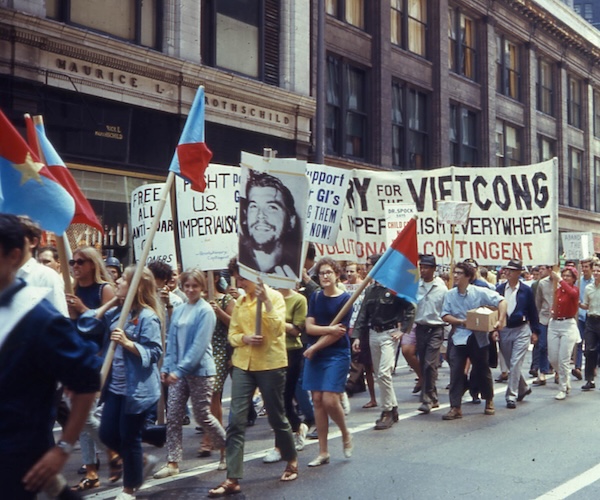
Historian Alexander Bloom offers a fresh perspective on the pivotal year of 1968 in his new book, "1968: The Year the World Shook," published in February. Bloom, who spent much of his academic career teaching 20th-century American history at Wheaton College, explores events beyond the United States, focusing on significant global locations such as Paris, Prague, and Mexico City alongside the U.S. backdrop of Chicago.
Read More
Originally conceived as a short entry for Oxford University Press’s Very Short Introductions series, the project expanded to nearly 400 pages, reflecting Bloom's desire to reshape common stereotypes surrounding the counterculture of the time. He believes that these stereotypes, often associated with sex, drugs, and rock ‘n’ roll, oversimplify a complex year and diminish its significance. Bloom emphasized that his work was intended for a general audience rather than solely for academic peers.
In an interview, Bloom addressed various factors that led up to 1968, including Martin Luther King's opposition to the Vietnam War, which gained traction in 1967. He noted that establishment figures began to question the war, indicating the growing unrest that would culminate in the events of 1968.
Throughout the writing process, Bloom learned about key events in cities outside the U.S., admitting that his knowledge of places like Paris and Prague was less extensive than that of Chicago prior to his research. He also reflected on his changing view of Robert Kennedy, describing how additional research revealed the depth of Kennedy's potential and evolution from his earlier political roles.
Bloom, who graduated from the University of California at Santa Cruz in 1968, recalled the countercultural environment of the campus and his choice to become a teacher to defer military service. He also spoke to the challenge of labeling a single year in the 21st century as an analogue to 1968, mentioning the impact of events like 9/11 but noting that more recent years lack the same definitive upheaval.
As a 21st-century historian, Bloom expresses a desire for a future that potentially mirrors the transformative spirit of 1968 but acknowledges that current societal enthusiasm leans towards achieving a stable and tolerable present rather than an idealistic future.
Blake Maddux is a freelance journalist contributing to several publications, including The Arts Fuse and the Providence Journal.