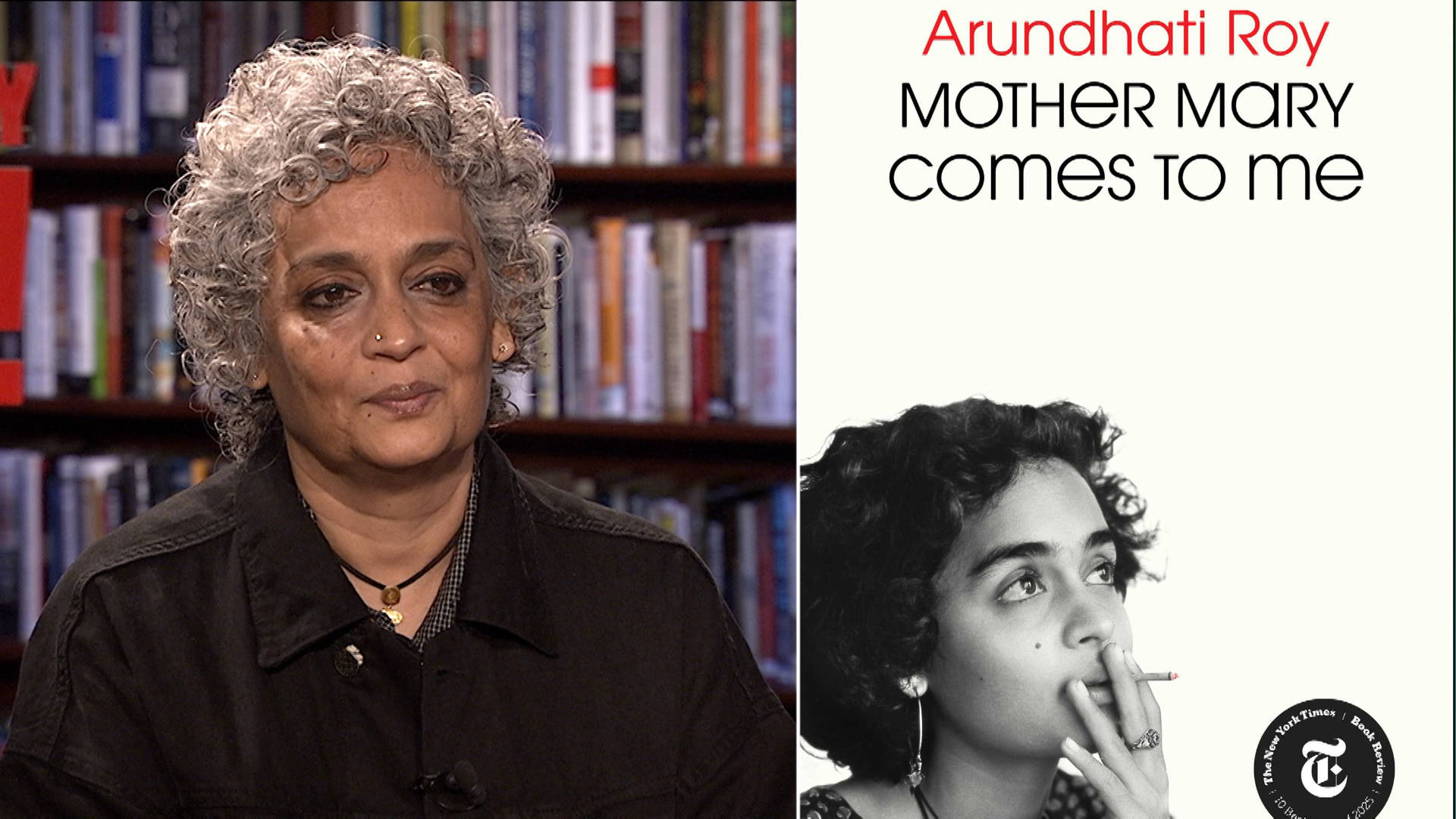
Arundhati Roy, a prominent writer known for her novels including "The God of Small Things," recently published her memoir "Mother Mary Comes to Me," which explores her complex relationship with her mother, Mary Roy, an influential educator and activist. Known for her criticisms of U.S. foreign policy and India’s treatment of dissent, Roy discussed her latest work and current geopolitical issues during an interview with Democracy Now! in September.
Read More
In India, Roy has consistently faced backlash from authorities due to her outspoken views against Prime Minister Narendra Modi and the ruling Bharatiya Janata Party (BJP). Her book "Azadi: Freedom. Fascism. Fiction" was among those banned in Indian-occupied Kashmir as part of efforts to silence criticism.
"Mother Mary Comes to Me" focuses on her mother, detailing her life as a fierce figure who inspired and challenged Roy. Reviewers have noted its dark humor and emotional depth, with The Times describing it as a story of an "impossible, inspirational woman who shaped her as a writer and an activist."
In the interview, Roy shared her thoughts on the memoir's title, derived from The Beatles' song "Let It Be," and its significance in her life. She expressed how music influenced her courage to leave home at 18, highlighting the nostalgic connection she maintains with the song's themes.
Roy discussed her mother’s legacy in the context of women's rights in India, specifically mentioning Mary Roy's successful fight for equal inheritance rights for Christian women, which culminated in a Supreme Court ruling that overturned discriminatory laws.
Reflecting on their tumultuous relationship, Roy described the duality of her mother as both a nurturing figure and a source of hardship. She recounted incidents that illustrated her mother’s complex personality, touching on how Mary Roy's fierce standards impacted both her children differently.
Roy stated that her childhood experiences imbued her with a keen awareness of social issues, which informs her activism. She expressed an ongoing commitment to advocating for those who face injustice, particularly in contexts like Gaza where children are suffering due to ongoing violence.
Throughout the discussion, Roy linked her personal narrative with broader themes of authoritarianism, connecting the situation in India under Modi’s regime to global trends. She emphasized the normalization of violence and intolerance, drawing parallels between the political climates in the U.S. and India.
As the conversation shifted towards the situation in Gaza, Roy condemned the actions taken against civilians and expressed her frustration with the international community's response. She articulated a sense of helplessness regarding the violence but asserted the necessity of continuing to speak out against such injustices.
Roy's commentary serves as a reminder of the interconnectedness of personal histories and larger political narratives, illustrating her belief in the power of literature as a means of resistance and reflection.