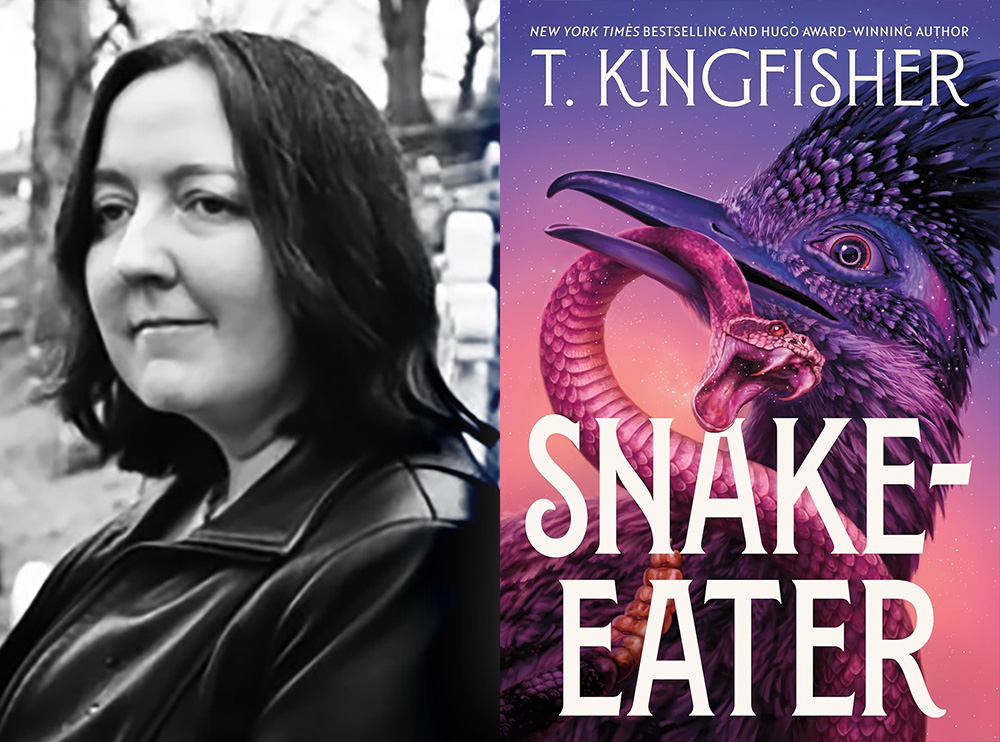
Author T. Kingfisher discusses her latest book, 'Snake-Eater,' a contemporary fantasy that blends horror with the story of a woman relocating to the remote desert of the U.S. to escape her past, only to confront the wrath of a vengeful god. The interview includes an excerpt from the novel at the end.
Read More
Kingfisher was inspired to write 'Snake-Eater' by her love for the desert, cultivated during her years living in Arizona. She began writing after envisioning a dog lying on a porch, which led to thoughts of dusty roads and local wildlife, allowing the narrative to develop organically.
When asked about her attraction to the fantasy and horror genres, she admitted that realistic fiction doesn’t resonate with her. Instead, she often thinks, “You know what would solve this? Ninjas. Or dragons.” This inclination shapes her unique storytelling style.
Her narrative style also balances humor and horror; she noted that humor often emerges in dire situations, much like the characters in the show M*A*S*H*. This blend helps release tension for readers, providing breaks in the suspenseful narrative.
The book features a diverse group of female characters. Kingfisher emphasized the importance of authenticity, stating that her characters, while flawed, are relatable in their struggles, not hiding any deep, dark secrets but simply navigating life’s challenges.
Recurring themes in her work include nature, often presented in unusual contexts. She noted that her typical horror scenario involves a newly single woman alone in a daunting setting, frequently accompanied by an animal companion.
Explaining the theme of found family in 'Snake-Eater,' Kingfisher described it as identifying those friends who can share silent, comfortable moments with you, and also those who would support you in extreme circumstances, illustrating the essential human connections that often replace failed familial relationships.
Incorporating natural elements is significant to her writing. Kingfisher identifies as an enthusiastic amateur naturalist who sometimes has to restrain her impulse to overwhelm readers with details. She learned, for instance, that scorpions are quite sensitive to green light despite their poor vision, a surprising discovery during her research for 'Snake-Eater.'
Her fascination with roadrunners led her to give them a prominent role in the novel; she noted they are fascinating creatures—part dinosaur, part predator—highlighting their unexpected and sometimes grim behaviors that contrast with their cartoonish portrayal.
Kingfisher’s favorite character to write in 'Snake-Eater' was Grandma Billy, whose interactions with Father Aguirre provided much enjoyment for the author.
A prolific writer for both adults and children, she shared her writing process: starting her day with a drink and some garden contemplation, and then aiming to write a minimum of a thousand words each session to keep up with her goals.
When asked about the main message of the novel, Kingfisher suggested it might be a call to respect the desert's unique and often deadly beauty, especially as development threatens its existence.
An excerpt from 'Snake-Eater' depicts the protagonist, Selena, arriving at her late aunt’s house in the desert. She reflects on the house’s incongruity amid the harsh landscape and her own emotional state, showcasing the narrative's exploration of loss and belonging.